Here’s why you’re slow this Winter.

We’ve analysed 2 million rides to find out. Do we ride slower in winter? and if so why. Purely to make ourselves feel better about our current off season performance.
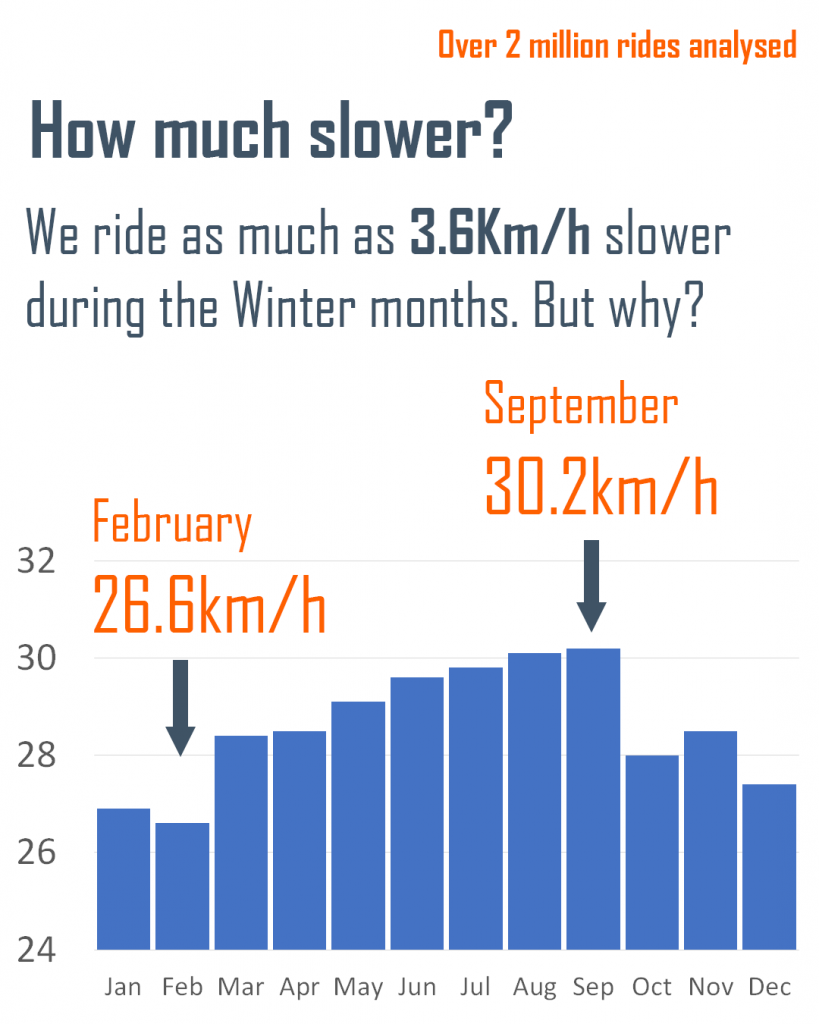
February is the Slowest month, with an average ride speed of 26.6kmh. Speeds begin to pick up in March, rising through Spring and Summer, to peak in September at 30.2kmh.
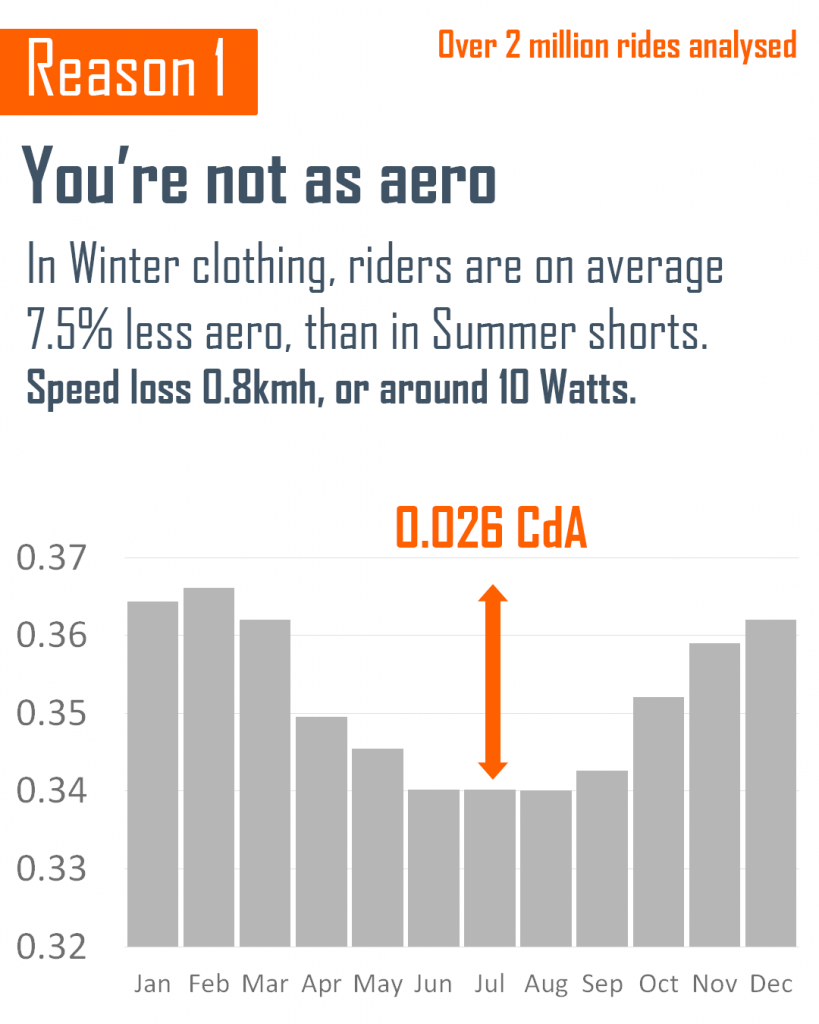
The first reason, in our unique analysis of 2 million rides, is the reduction in aerodynamic efficiency. CdA is the overall measurement of an object’s efficiency moving through the air. As CdA increases so does the power to maintain the same speed. Or, a reduction in speed for the same power.

myWindsock calculates CdA for every ride that has power data. Subscribers can monitor their aerodynamics ride by ride, learn more.

In February, CdA is 7.5% higher than in July where the average CdA was 0.340, compared to 0.366 in Winter. The difference at an average speed of 30.2kmh is around 10 Watts.

Why? We don’t dress quite as minimally as we do in the Summer. Short sleave jerseys are replaced with rain and wind repellent jackets. Lights, mudguards and less aerodynamic bike frames also contribute to the reduction in aerodynamic efficiency.
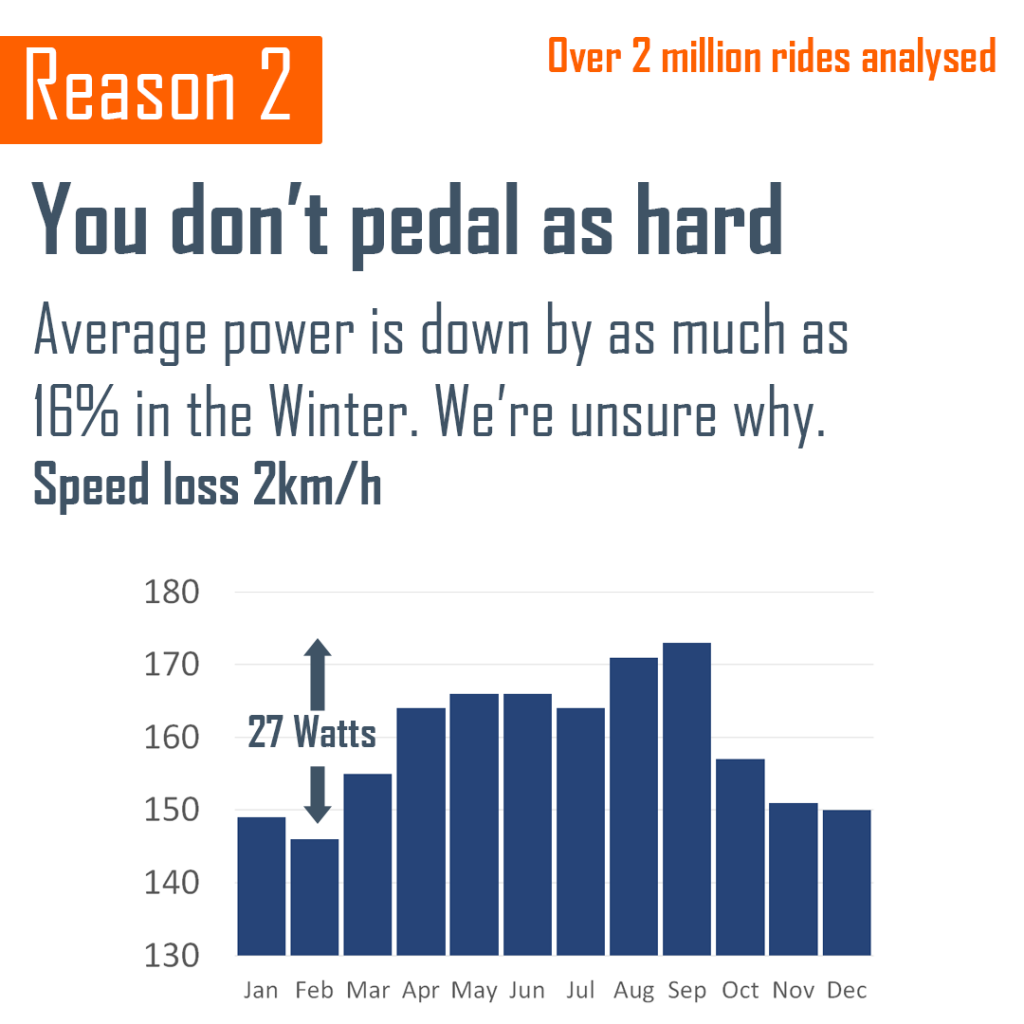
Reason 2, cyclists in Winter don’t pedal as hard. We expected this, however we are suprised at by how much. Riders are averaging 173 Watts in September. By February we are down to 146 Watts. On our Instagram page @mywindsock we’ve had so speculation as to why this is.

@itsjakevita
“Most cyclists that train only do Z1/2 rides all Winter and the higher FTP stuff in Spring/Summer.”

@ade_fox71
“Wet slippy roads, cold temperatures never good for fast riding. “

@fazzasphotos
“Keep some spare energy to get home as you don’t want to be on your last legs and breakdown at 2 degrees. Plus it’s mainly endurance, efforts are done on Zwift.”

The myWindsock population of athletes tend to be actively racing, this may also account for the difference in power. During Peak racing season1 to 2 rides a week are likely at full race pace during the Summer months.
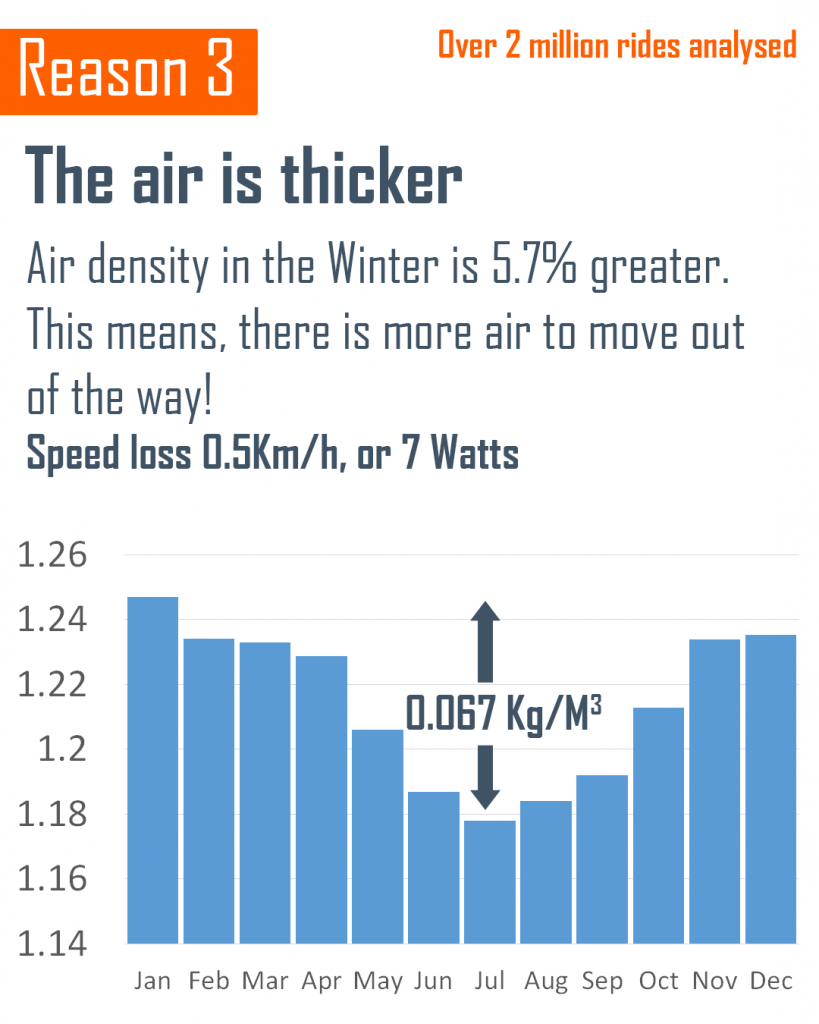
A very typical myWindsock weather stat here. Air Density becomes greater as the temperature decrease. Meaning, in the Winter, there is literally more air to move out of the way when riding along. The air density between Summer and Winter can cost as much as 7 Watts, or 0.5kmh off the average speed.

Conclusion

If your speed is lower in the Winter, you’re in good company. You now know it’s a combination of your clothing, a natural change of pace and the colder air holding you back. For safety, it’s probably not a bad thing our speeds are a little bit lower. Carrying a little less speed into potentially slippy corners is not a bad thing. It also makes Summer special. Remember ‘Winter miles mean Summer smiles’.

Would you like to discover more about your own rides? It’s easy to discover your CdA and more about the weather conditions you ride in. Start by signing up to myWindsock and connecting your Strava account for free.
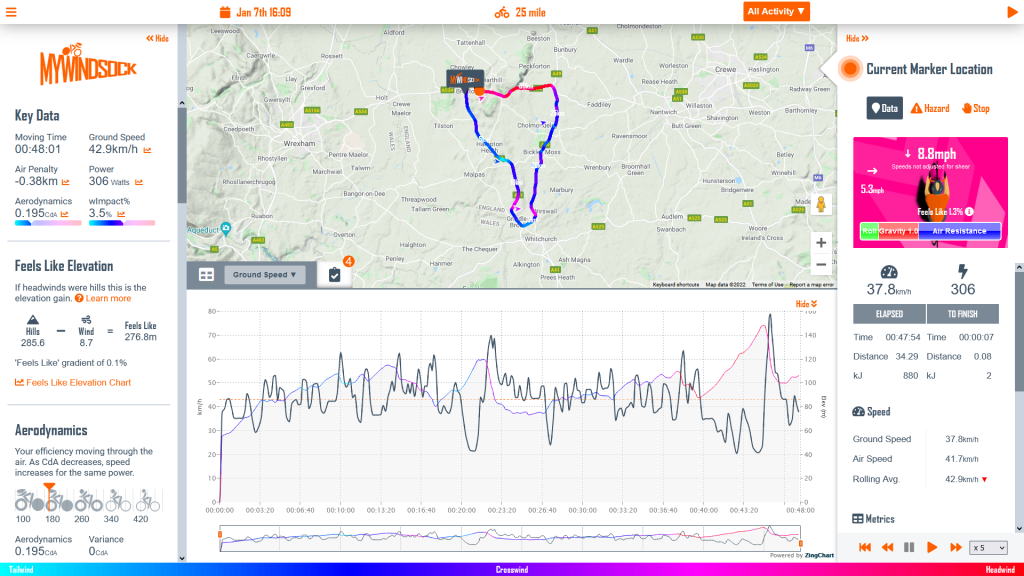

Updated Desktop Interface

We have been working on the desktop user interface. We noticed, the most frequently selected chart item was ‘Summary Data’. Switching between the activity or interval Summary, whilst experimenting or learning about your activity, isn’t very efficient.
In desktop view, you can now view the Summary Data (left panel), along side charts and Current Marker Location (right panel).

You may not always want the Summary in view, or even charts and Current Marker Location. So we have added the functionality to hide each of these as required. Simply click on the “Hide” button on the required panel.

$50 Off a Notio Aerometer! When you upgrade this Black Friday Weekend.

Enhance your myWindsock analysis* and measure your CdA in real time, with the world’s premiere on-bike aerometer. Maximize your gains by testing your position and equipment for the ultimate aero advantage.

Upgrade to any myWindsock Premium (yearly) plan, this Weekend, to receive $50 Off a Notio Aerometer!

Upgrade from only £9.99/$14.99 per year, to receive this offer. Learn more

Already a Premium member? Click here.

What is a Notio?

Attach a Notio to your bike and you’ll be recording live air speed data. With this data, your aero computations are enhanced with moment by moment calculations. Combine a Notio with myWindsock Premium and you’ll have the ultimate package for aerodynamic analysis*

How Aero Analysis helps you go faster

To go faster you can either produce more power, or become more efficient. One of the ways to become more efficient is to move through the air with less resistance. Making changes to your position, or choosing better equipment, can lead to big improvements in your aero efficiency.

myWindsock Premium enables you to track your aero changes and make informed choices.

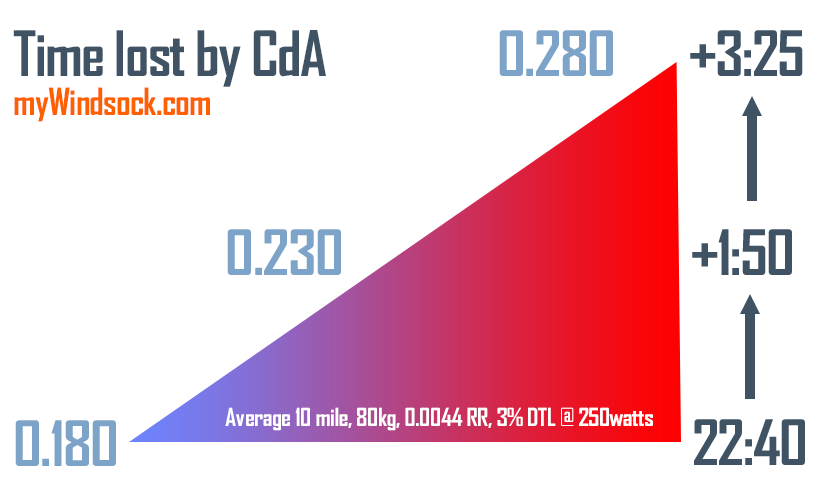
We measure your efficiency in CdA. The more efficient you are at moving through the air, the lower this number will be. Typically a road cyclist will be between 0.300 – 0.400. A racing cyclist on a road bike will be in the 0.250-0.300 range. Time trial cyclists will be even lower, with some specialists below 0.180.

Learn more about myWindsock’s aerodynamic analysis.

Get the upgrade offer

Upgrade this Weekend to any myWindsock Premium package, to receive a Notio $50 Off voucher. Offer available 26th-28th November 2021. Please note the Voucher must be redeemed this Weekend.

Upgrade now from only £9.99/$14.99 per year, to receive this offer. Learn more

View Premium Upgrade Options

Already a myWindsock Premium subscriber? Get your Voucher

Offer valid for myWindsock Premium subscribers only, while stocks last. Offer begins Friday November 26 at 12:00am.

*Notio data analysis in myWindsock is expected January 2022.

Black Friday Weekend: $50 Off a Notio Aerometer!

You already cheat the wind with myWindsock Premium, but now you can get even more aero with $50 off a Notio! Measure your CdA in real time with the world’s premiere on-bike aerometer and maximize your gains by testing your position and equipment for the ultimate aero advantage.

Not already a myWindsock Premium subscriber? Upgrade now from only £9.99/$14.99 per year, to receive this offer. Learn more

Claim your Voucher Code

What is a Notio?

Attach a Notio to your bike and you’ll be recording live air speed data. With this data, your aero computations are enhanced with moment by moment calculations. Combine a Notio with myWindsock Premium analysis and you’ll have the ultimate package for aerodynamic analysis*

*Notio data analysis in myWindsock is expected January 2022.

How Aero Analysis helps you go faster

To go faster, you can either produce more power, or become more efficient. One way to be more efficient is to move through the air with less resistance. Making changes to your position, or choosing better equipment, can lead to big improvements in your aero efficiency and speed.

myWindsock Premium enables you to track your aero changes and make informed choices.

We measure your efficiency in CdA. The more efficient you are at moving through the air, the lower this number will be. Typically a road cyclist will be between 0.300 – 0.400. A racing cyclist on a road bike will be in the 0.250-0.300 range. Time trial cyclists will be even lower, with some specialists below 0.180.

Learn more about myWindsock’s aerodynamic analysis.

Claim your Notio voucher code

Please enter your email below to receive your Black Friday $50 Off Notio Voucher.

    When purchasing please use the same email address as your myWindsock Premium account for verification.

    If you aren’t a myWindsock Premium subscriber, you must upgrade now to redeem this offer. Premium starts from as little as £9.99/$14.99 per year.

    Offer valid for myWindsock Premium subscribers only, while stocks last. Offer begins Friday November 26 at 12:00am.

    3 must know Premium stats, post-ride.

    Premium gives you many more fascinating insights into your activities. Here is a run down of some pretty cool things to look at post-ride.

    Feels Like Elevation

    A Feels Like Elevation chart.

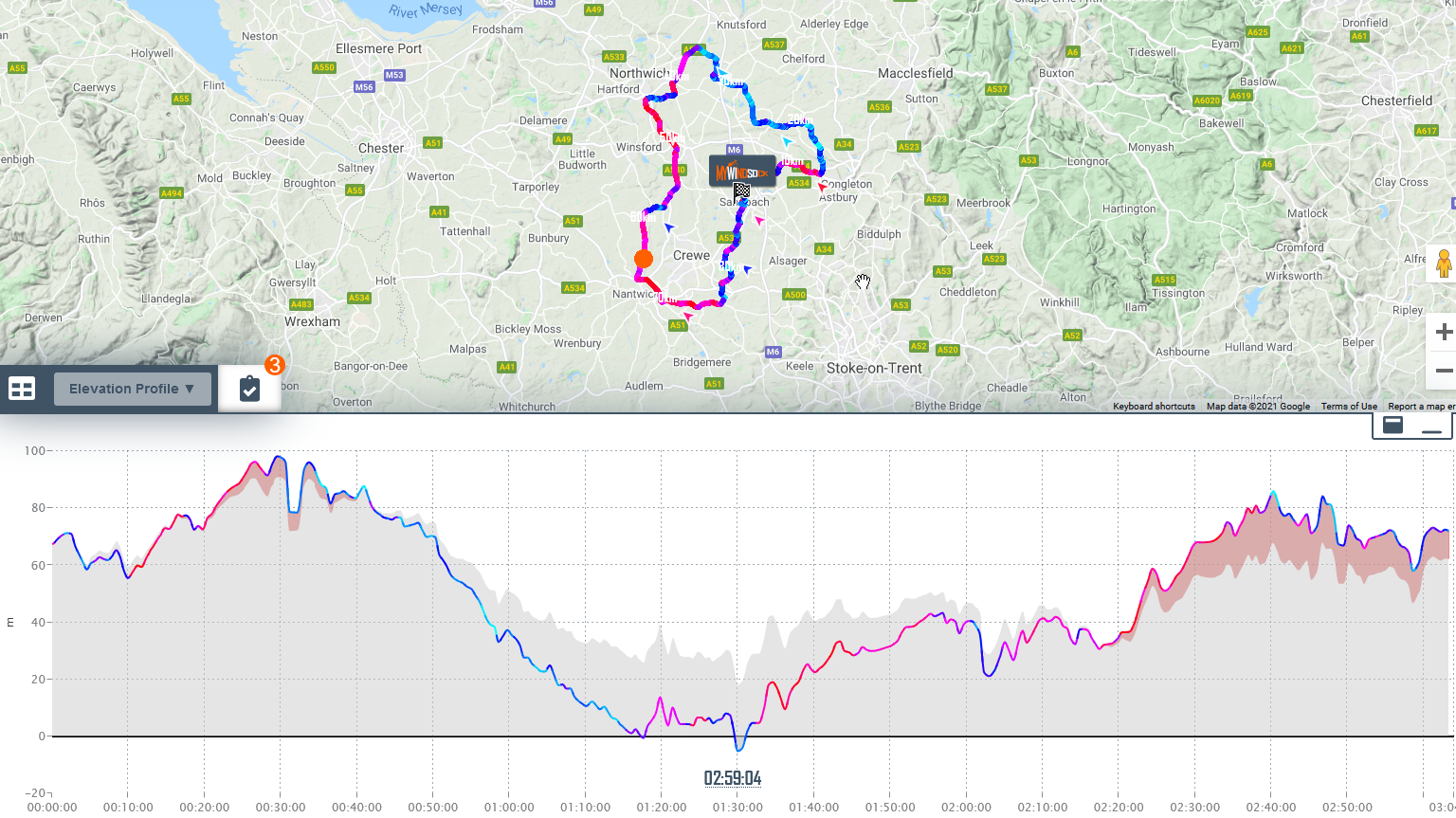
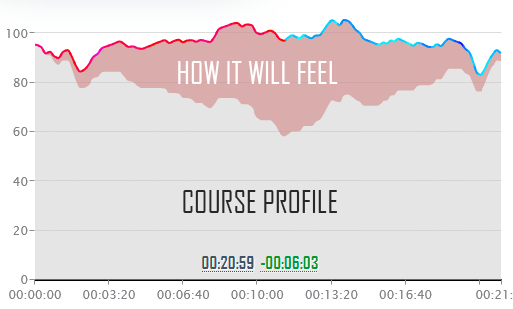
    Metres or feet climbed on any ride gives an insight into how tough the terrain was. Bragging rights are given when huge elevations are ridden. We’ve developed Feels Like Elevation. A combination of the wind and elevation to give a true picture of how tough a ride was.

    Whilst the elevation profile indicates it’s down hill out and up hill back, combine the feel of the headwind the profile looks a lot different.

    Headwinds will increase the elevation by the relative effort to ascending hills. Similarly a nice tailwind will make the road feel a little more down hill and the elevation profile is corrected to reflect this.

    Learn more

    Ride Aerodynamics

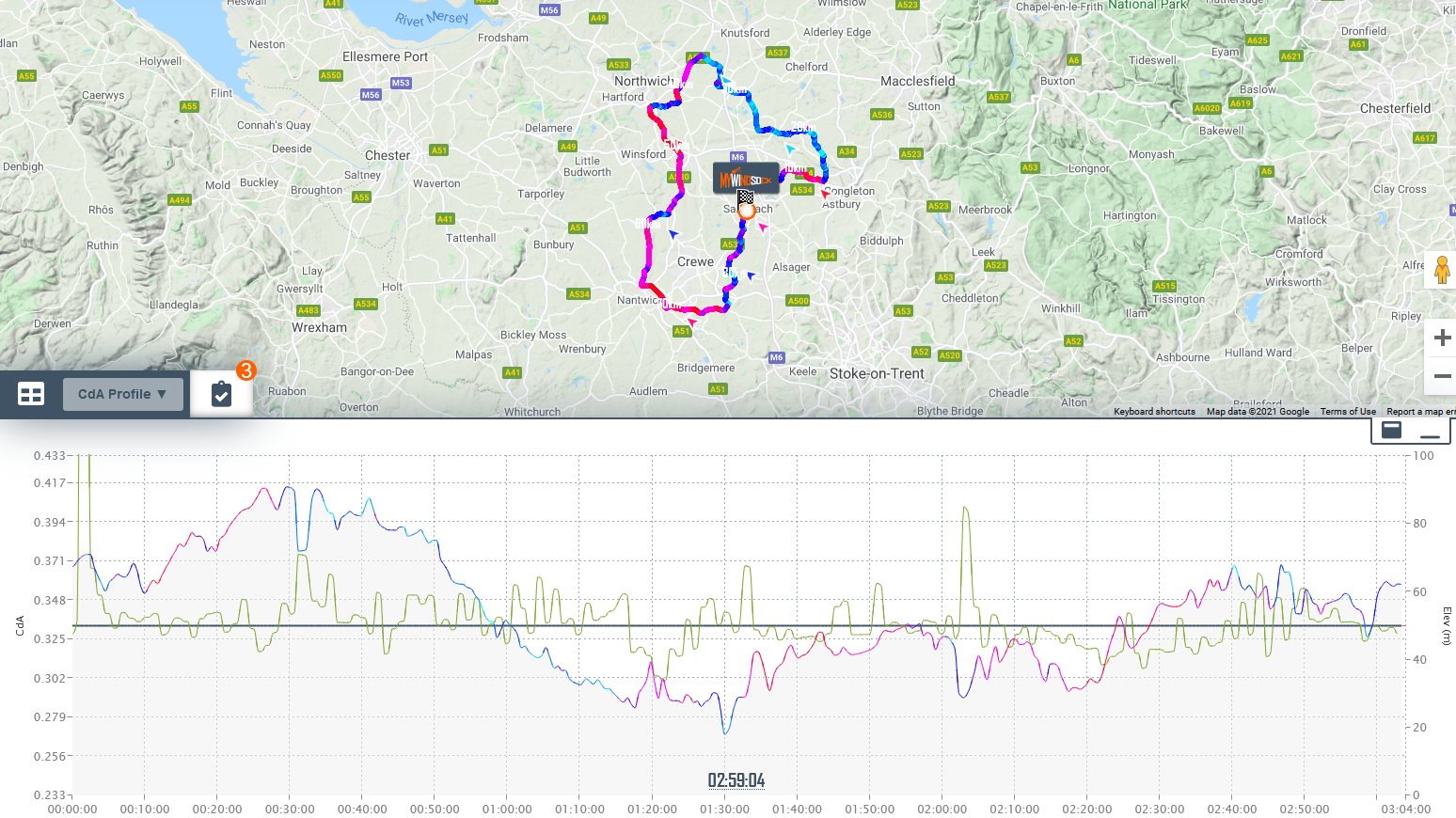
    The CdA Profile depicts your aero efficiency during your ride.

    Just how aero are you? Aerodynamics can now be tracked, just like your FTP and other performance metrics. Having an eye on these numbers during training keeps you in the competitive athlete mind set. Aerodynamics is reported in a metric called CdA. The lower your CdA is, the faster you will go for the same power.

    Go further this Winter and actively work on your aerodynamics. Train your ability to hold your position.

    Pro tip: Find a repeatable loop of a around 10-20 mins, where you can safely focus on your position. Complete 4-5 loops and see how your CdA alters on each loop. Do you start to notice a change with fatigue? See how steady you can keep the CdA.

    Learn more

    Weather Impact

    Weather Impact is a key myWindsock Premium metric. It combines all enviromental factors to give a definitive rating of how great the a cost or benefit the weather was. We add this metric to your past rides, routes and very interestingly Strava Leaderboards.

    On every Strava Segment effort we record the Weather Impact. On your latest activity use the Premium Strava Segment Filter to reveal the interesting Segments you rode through. Then access the Leaderboards, view how your best efforts compare and the top 10 Weather Impacts.

    Learn more

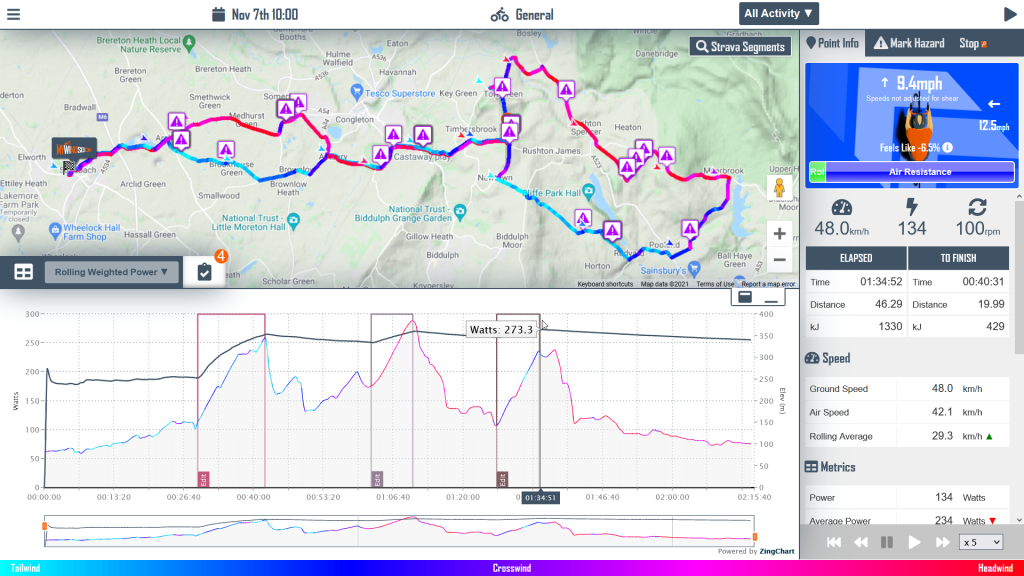
    Load Activites & Routes

    More benefits with Full Premium

    Weather Trends

    Included in LITE, POWER and RACE

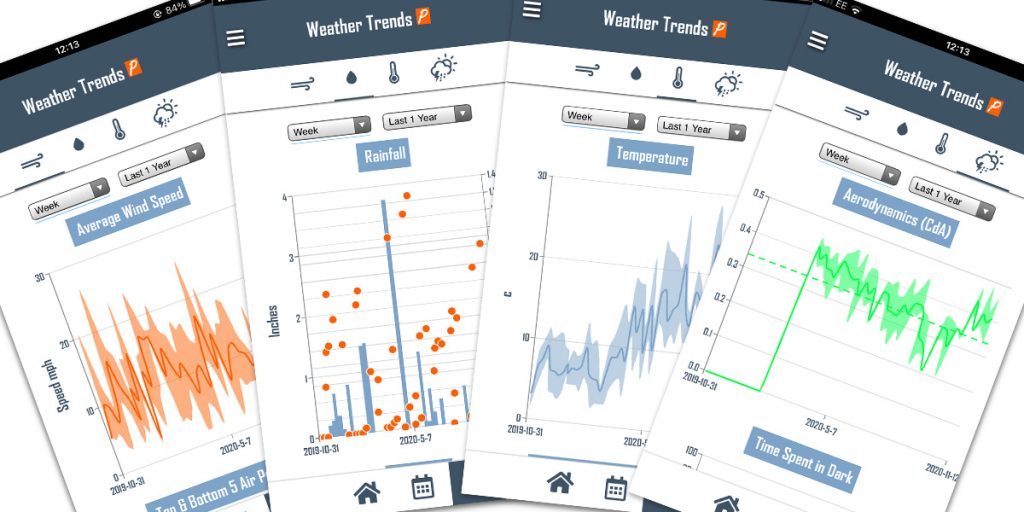
    Track your weather over time. Track the toughest headwinds, the heaviest rainfall and the highest & lowest temperatures.

    Strava Segment Windsocks

    Included in LITE, POWER and RACE

    Don’t miss out on the perfect day. Activate a Windsock on any Strava Segment and when the conditions are optimum you will receive a notification.

    View Premium Options

    7 Day Premium Unlock

    We’ve taken the Premium lock off your account! So you now have the opportunity to experiment with all the Premium Map features we’ve been building.

    Some of the Features to try

    * Strava Subscription required
    ** Power Meter Required

    Get Started

    Simply start browsing your Actvities & Routes to begin. Need a bit of help? Find out how to load a route into myWindsock here.

    Open Activities & Routes

    Keep these features and save 50% Off Premium POWER

    Premium POWER is our most popular Premium plan and we’re offering it to you with 50% off. Use the voucher code ‘nov21’. Or simply click here.

    Usual price 29.99GBP / Year, offer price 14.99GBP / Year. Offer ends 2021-12-01.

    Planning an interval session

    Doing just enough to elicit the maximum training affect is the most efficient way to train. myWindsock can help you pick out the best locations for your intervals and plan their intensity.

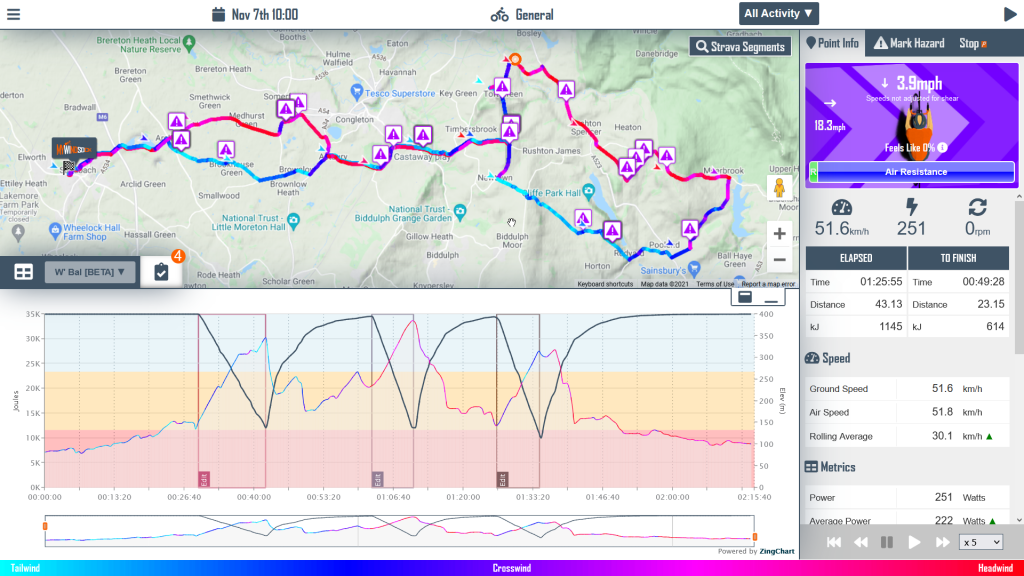
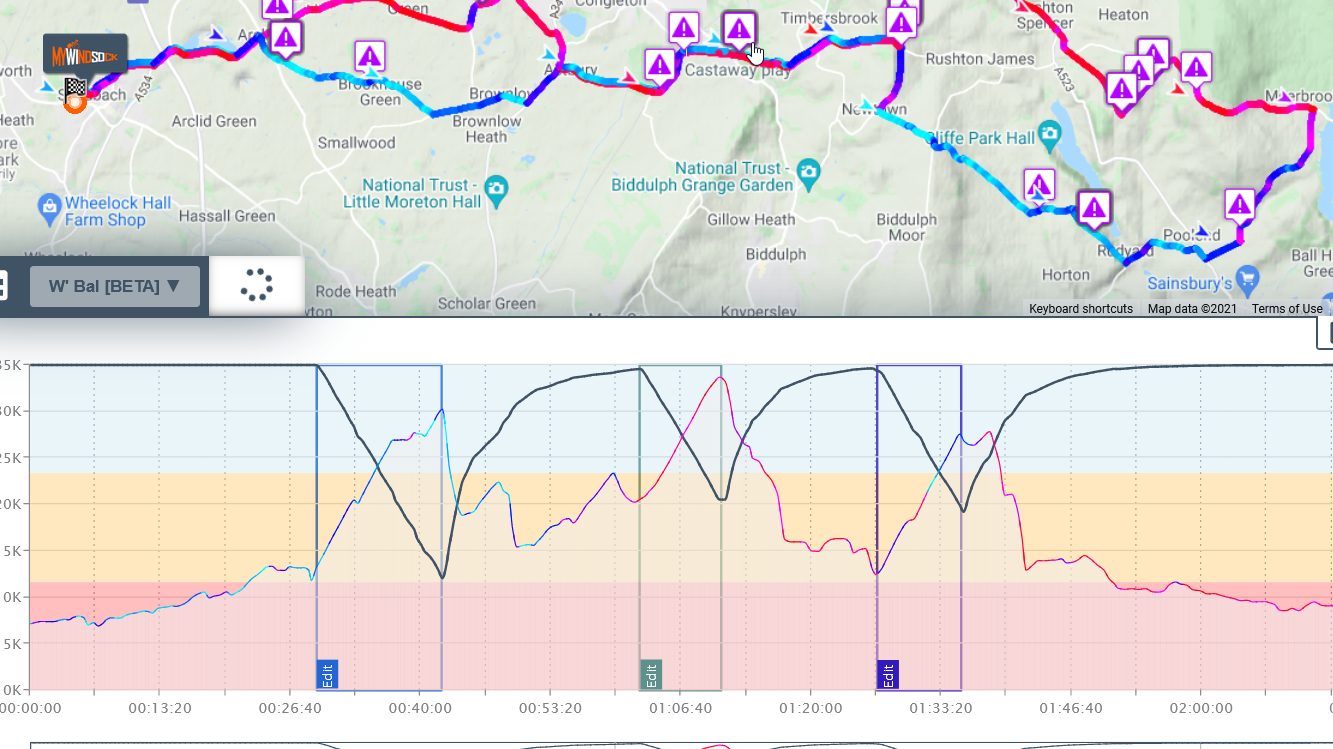
    I’ll show you how to get an interval plan looking like this. Three intervals depleting similar amounts of W’, your work above Critical Power.

    Creating the intervals

    I begin by picking a chart that will assist us in planning our intervals. For this paticular session, I am attempting to deplete the same amount of W’, or Kilojoules above Critical Power, on hills with differing lengths. I would like to know how much power to put out on each hill to deplete the same Kiljoules of work above Critical Power.

    As I am interested in the W’, it makes sense to plan our intervals with the W’ Bal chart.

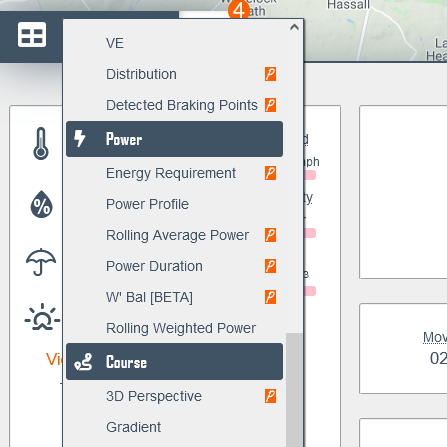
    W’ Balance Chart is under Power in the Chart Menus

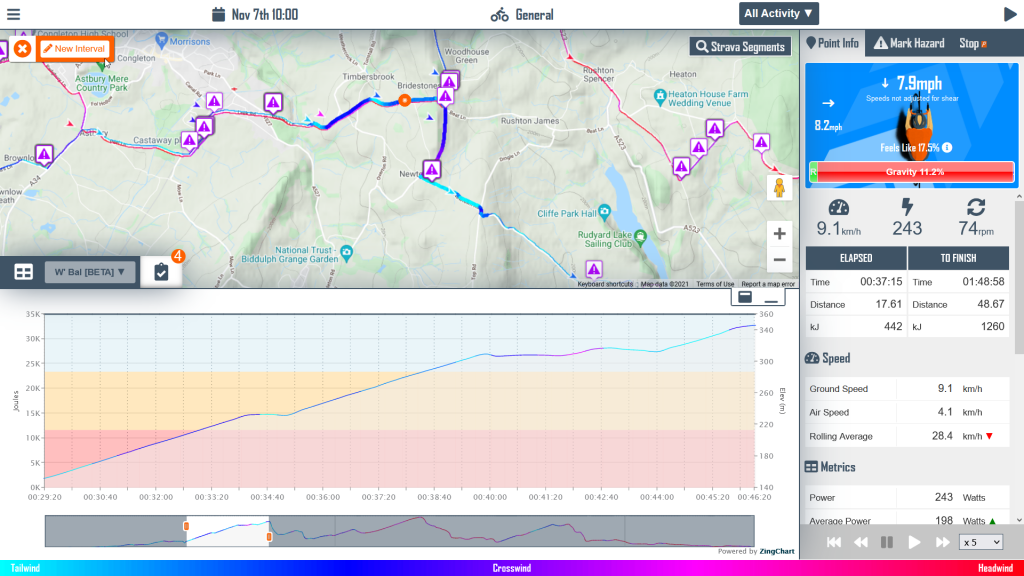
    Next I simply drag, or highlight a selection of the chart. When I am happy the correct part of the route is in the chart view and highlighted on the map, I click “New Interval”.

    Click New Interval when you are happy with the selection.

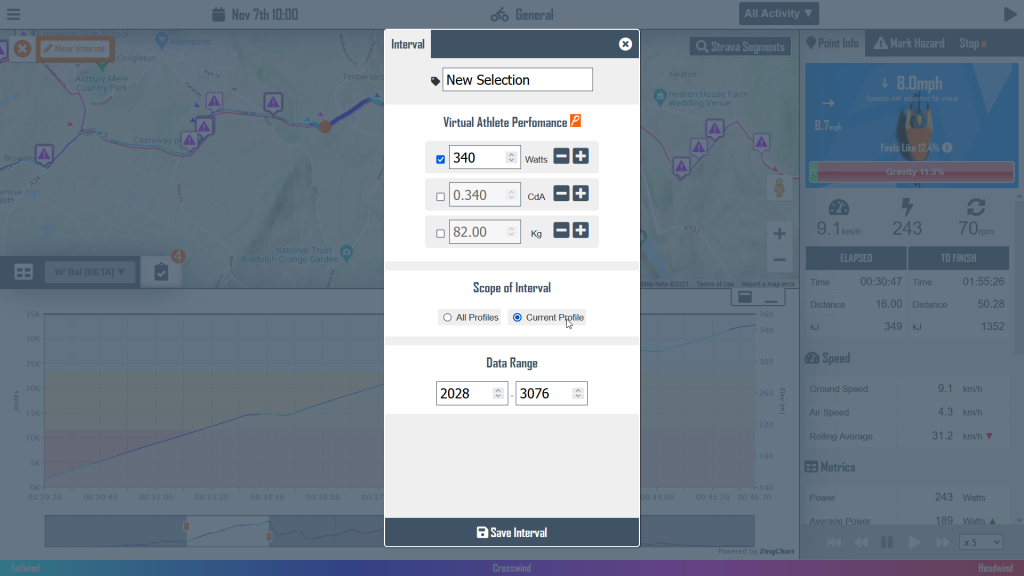
    I now add the interval parameters. I’ll start with 340 Watts.

    I finish by clicking “Save Interval”. I then will repeat this for the next two hills, creating three intervals in total. Remember to click “Apply Changes” to reveal the result of the intervals.

    Three intervals, W’ Balance graph shows the depletion of energy above Critical Power.

    However due to the differing length of the hills this workout wouldn’t deplete all of the require W’ for the session. Let’s see if we can even them up.

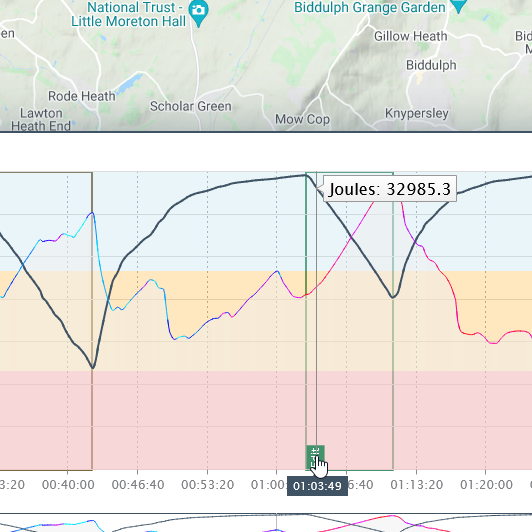
    Clicking the edit button on the interval marker will open the interval edit.

    Opening up the interval editor, we can add a few extra Watts to each of the hills we were short of Kilojoules. After a little adjustment we can now see even W’ depletion for all three intervals/hills.

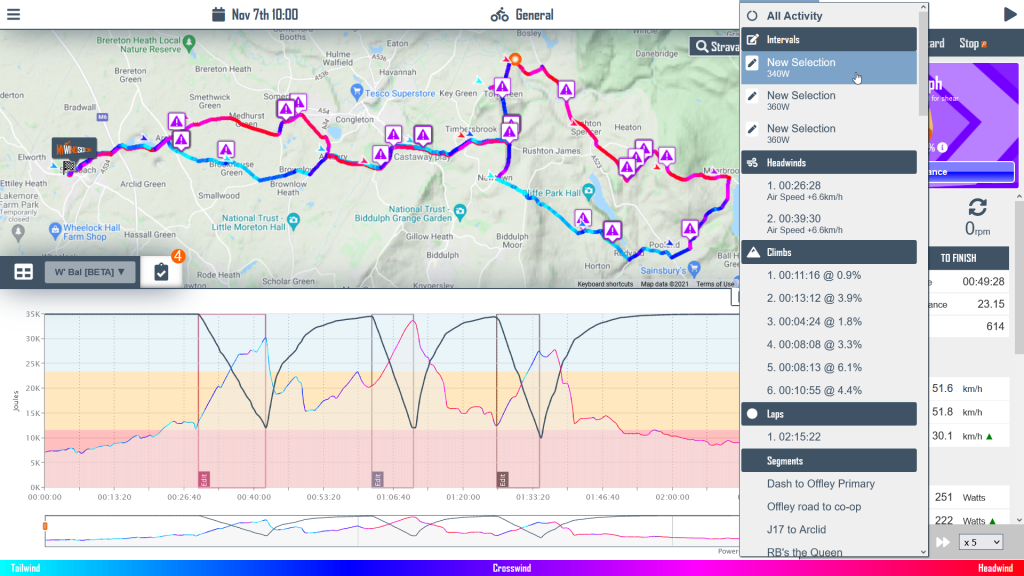
    The Navigator menu reveals key selections including Intervals we have created.

    I now have a power plan for the interval training session. Let’s see what couple more charts tells us.

    Power Profile shows the planned power for my interval session
    Rolling Weight Power, how our Weighted Power evolves during the session.

    What’s holding you back : Winnats Pass in Graphs

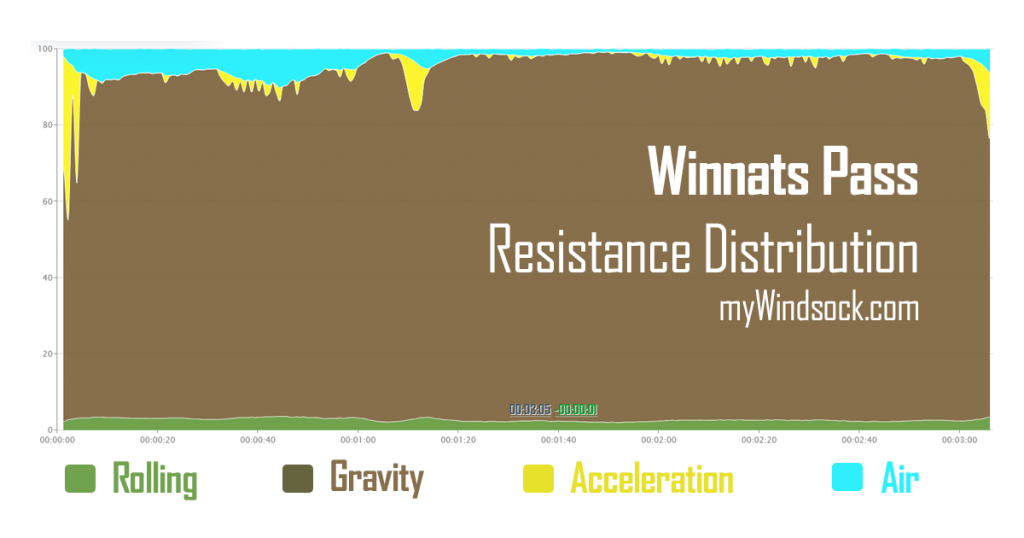
    The above Resistance Distribution, is based on our estimates of a male podium finisher. We’ve estimated this to be an athlete with an output of 7.7 Watts/kg. With a total mass of 70kg, averaging 540 Watts. Our predicted time for this rider is 3mins 5 seconds.

    The forces acting against each rider is very individual. By far the greatest force is gravity. It is no suprise that as we increase a rider’s weight, so does the proportion of energy required to move the rider up the hill. However there may be some interesting changes to the distribution of the other resistances.

    Live Winnat’s myWindsock data here

    Current Winnats Pass Forecast for 2021 Nationals

    How does resistance change for different riders

    Let’s face it, at 15% average, gravity is a huge part of the battle between Watts and Speed. However, with a few trips up the hill for our myWindsock Virtual Rider, we can see how each rider’s morphology has an individual mix of additional resistances to pay attention to.

    Increase Mass of Rider, bike & equipment

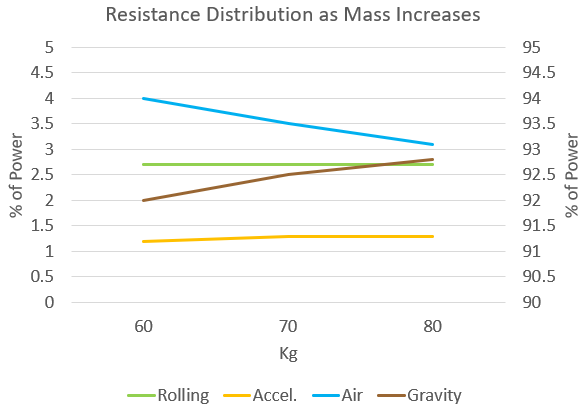
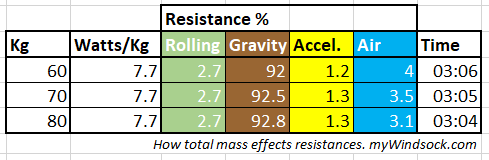
    Keeping our Watts/Kg the same, let’s see how three riders of 60Kg, 70Kg and 80Kg compare. Here we see an exchange in distribution between Air resitances and Gravitational resistance.

    Note, Gravity is using the right side axis. All others on left side axis.

    Look at how air resistance decreases, whilst gravity increases as a proportion of the rider’s energy consumption. Heavier riders are less affected by changes in the wind. See also, despite the power ratios being the same at 7.7Watts/Kg, a larger rider actually rides the hill quicker.

    Increase Rider’s Power Output

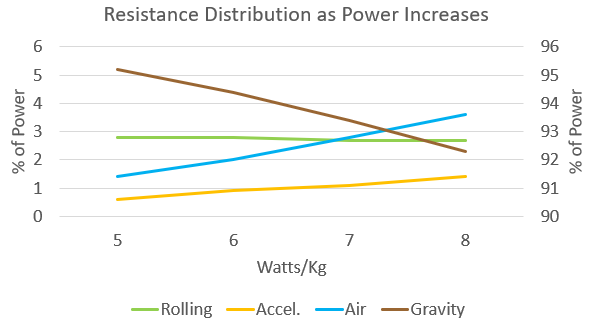
    Taking a 75Kg rider we then altered their power from 5Watts/kg up to 8Watts/Kg. As the power increases, the proportion of Air Resistance increases the most.

    Note, Gravity is using the right side axis. All others on left side axis.

    Here we see a similar exchange between Gravity and Air resistance. It’s interesting to observe that a less powerful rider will be impacted more by their bike and equipment weight.

    Also see that as a rider becomes more powerful, Acceleration increases as a proportion of energy expenditure. This is the energy required to change the rider’s speed. As power increases, rotational weight becomes more important.

    Conclusion

    You may not be able to change much about your morphology. At 6ft 2inches, I wish it was something I could train around September and October. However understanding your individual fight up the hill may give you some idea as to where to focus for that extra edge.

    Try your own experiments and learn about your individual hill climb. Live Winnat’s myWindsock data here

    Pacing : Winnats Pass in Graphs

    Our myWindsock Virtual Rider has tirelessly ridden the course to produce some super geeky data. Virtual Riders, ride the course as instructed by you. Give them a 1000 Watts, they’ll knock out 1000 Watts until you tell them to stop. The best thing is, they never get tired.

    myWindsock Virtual Riders testing every pacing scenario

    In this article we look at how best to pace the hill climb. We recommend following along and creating your own Virtual Rider with your own anticipated power, weight and up to data weather.

    You may want to jump straight to the results of our pacing investigation, it is here.

    Live Winnat’s myWindsock data here

    Let’s get straight to it, big start or big finish!

    Hill climbs all have their unique pacing strategy. A time trial isn’t a straightforward physical test. Dynamics of the course, such as gradient and air speed, should be considered when planning your effort.

    Luckily, we have a simple method to demonstrate where you save the most time for the additional power.

    Now, not all courses have the dynamics or weather and elevation profile to produce big variation. With “consistently steep” as Winnats description we’re not expecting dramatic changes from pacing. However a couple of seconds is likely up for grabs.

    Quick experiment to get us started

    First, we begin by simply adding a little bit more power to our Virtual Rider’s profile. In this example, we give our Virtual Rider an extra 10 Watts. As you’d expect, this reduced our Virtual Rider’s time. At 75kg, 10 Watts reduced the time by ~4 seconds.

    The purpose of adding the additional power is to find where it had the greatest effect on our time. Next, we look for clues in the ‘Last Change Delta‘ (LCD).

    Last Change Delta

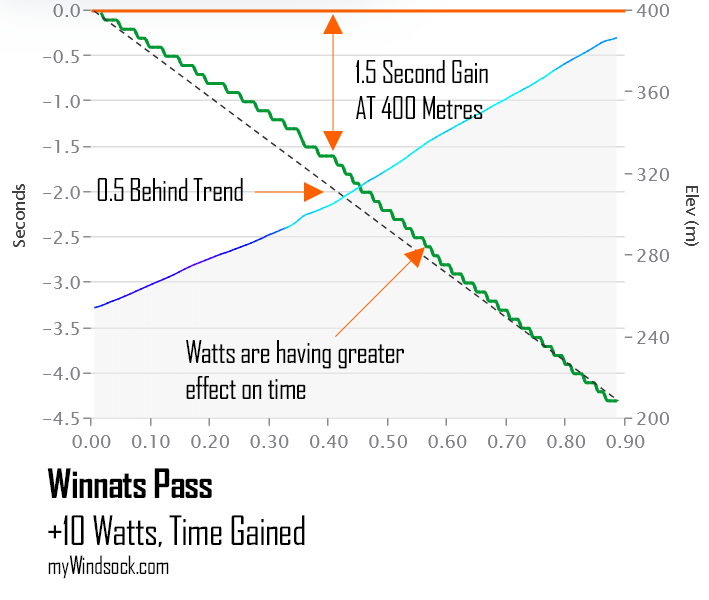
    Last Change Delta – every time you make a Virtual Rider change, a comparison to the previous setup is provided.

    The grey Trend Line shows the average time gained or lost by your last change. The green Delta Line, is indicating we are ahead and by how many seconds.

    The Delta Line would be red if we were behind. Up to ~300 metres the Delta Line is actually 0.5 seconds behind the Trend Line. This means, to this point in the race, we were gaining time slower than the overall trend. Remember we are still gaining time, just at a slower rate.

    After 400 metres, or around the right hand bend, the two lines start to converge again. This indicates we are now gaining time quicker than the overall trend. We want to capitalise on the parts of the course our Watts gain time at the greatest rate.

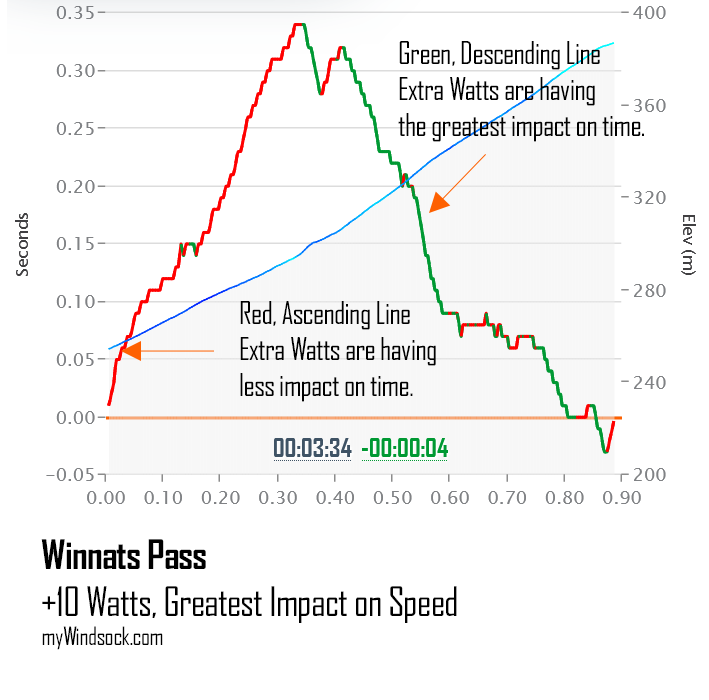
    Sometimes the variance from the overall trend is difficult to spot. The Delta Variance graph helps us to do this.

    The Last Change Delta Variance – catchy name.

    Let’s have a race

    Let’s compare two riders, one with power ascending and the other descending. We must be sure our Weighted Power is the same across each Virtual Rider. To ensure equal power I’ve tweaked the start and end points of our intervals. Our riders are 75kg including bike.

    First rider up, the Big Starter

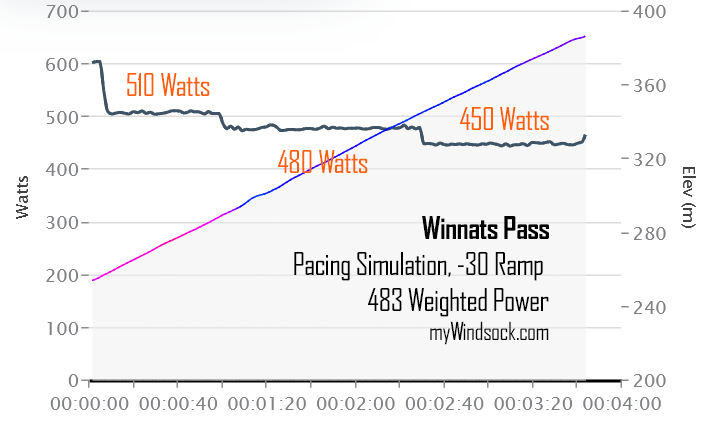
    This rider has gone hard from the start and then faded to the finish.

    Next up, the Strong Finisher

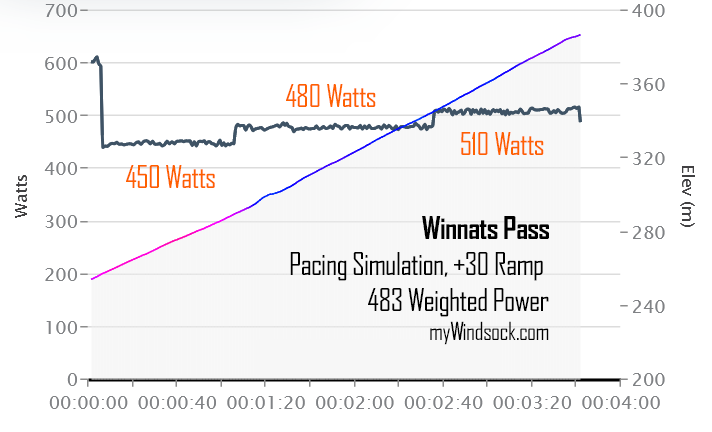
    This rider has tried the reverse method, building from 450 Watts to 510 Watts.

    Who wins?

    Let’s remember, we have adjusted these two riders efforts to ensure the same Weighted Power of 483 Watts.

    CompetitorTime
    Big Starter3:43.2
    Even Pacer3:41.5
    Strong Finisher3:41.0

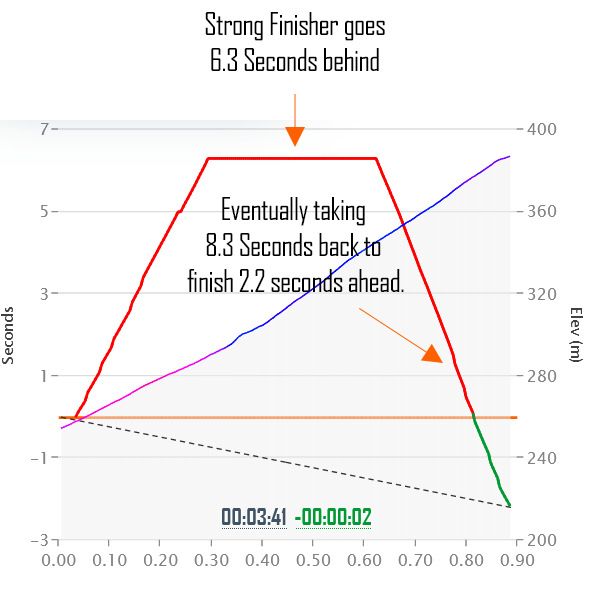
    Let’s again look at the Last Change Delta to see how this race unfolded.

    Conclusion

    Measuring your effort at the start is likely to yield a better result than getting too carried away. The same overall power but differing pacing strategies resulted in a 2.2 second gain by the Stronger Finisher. Interestingly the Even Pacer, was only 0.5 seconds behind the Stronger Finisher. Just don’t fade at the finish.

    Things to try, how much differential between the start power and finish. I did do a bit of tweaking and found a 60 Watt spread had the best return for the 75kg rider. I recommend trying this out for your own power and weight. See what happens when you increase or reduce the spread of Watts.

    Live Winnat’s myWindsock data here

    Monsal Head Hill Climb in Graphs 2021

    It’s the iconic Monsal Head hill climb this Sunday. Let’s take look at the course and it’s conditions with a few myWindsock Graphs. Could this be the year Malcolm Elliotts 1981 Men’s course record (1min 14.2secs) is bettered?

    Forecast as of 19:00 30th September 2021. View the latest Monsal Head 2021 Weather Forecast.

    The Forecast

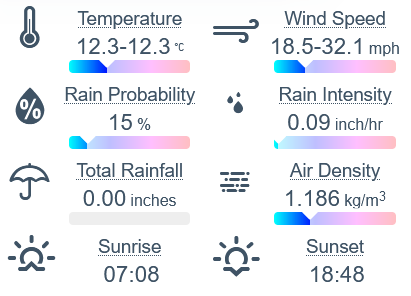
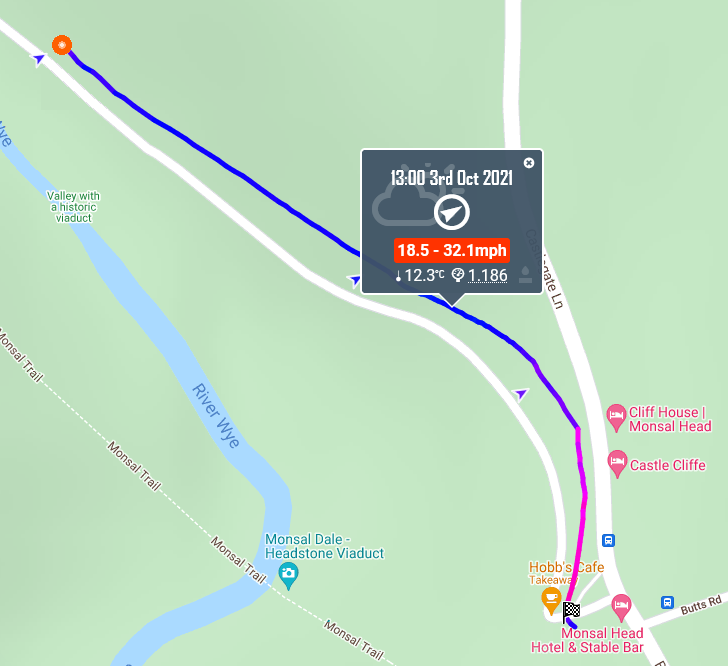
    Let’s start with the basics. The overall forecast is, cool temperatures and a strong WSW wind, gusting from 18mph to 32mph.

    A crosswind start turns gradually into a headwind by the finish.

    The Course

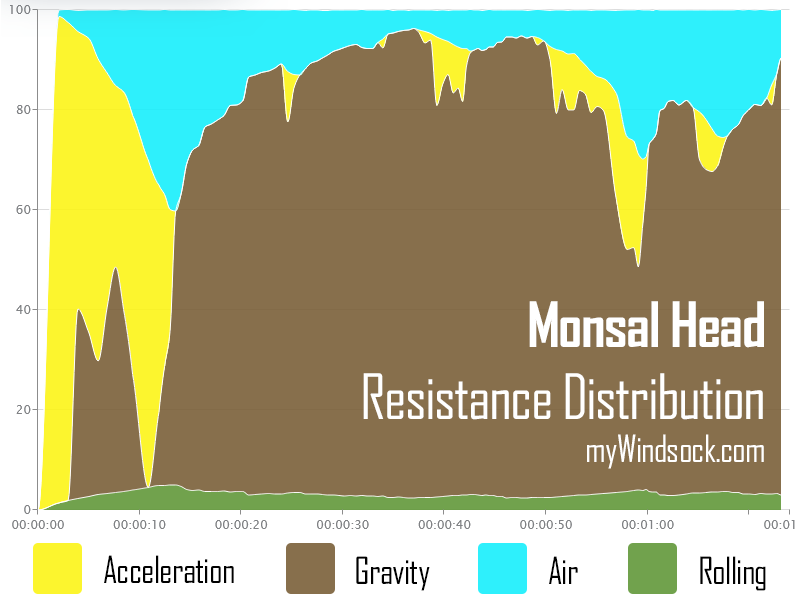
    The following myWindsock dynamics are computed for a record equaling 1min 14sec ride. 80KG total mass, 880Watts, 11Watts/kg.

    For the first 12 seconds, most of the rider’s Wattage is contributing to accelerating to 45kmh. Then the gradient bites quickly.
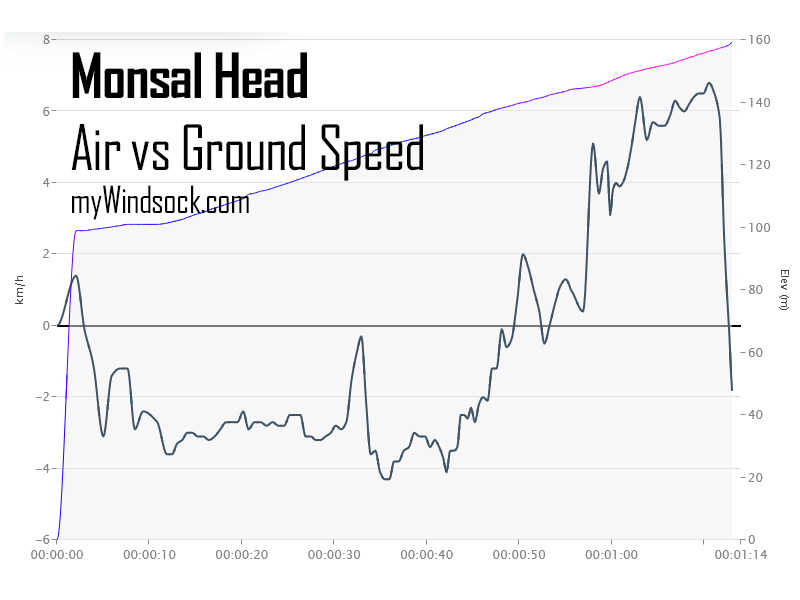
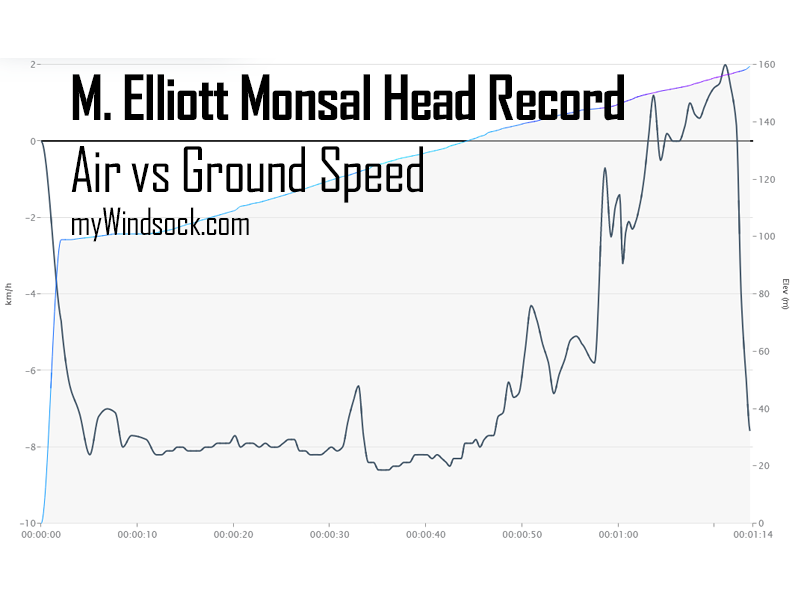
    Negative Air Speed during the first 30 seconds reduces air resistance. A higher air speed than ground speed, during the steepest section, increases air resistance.
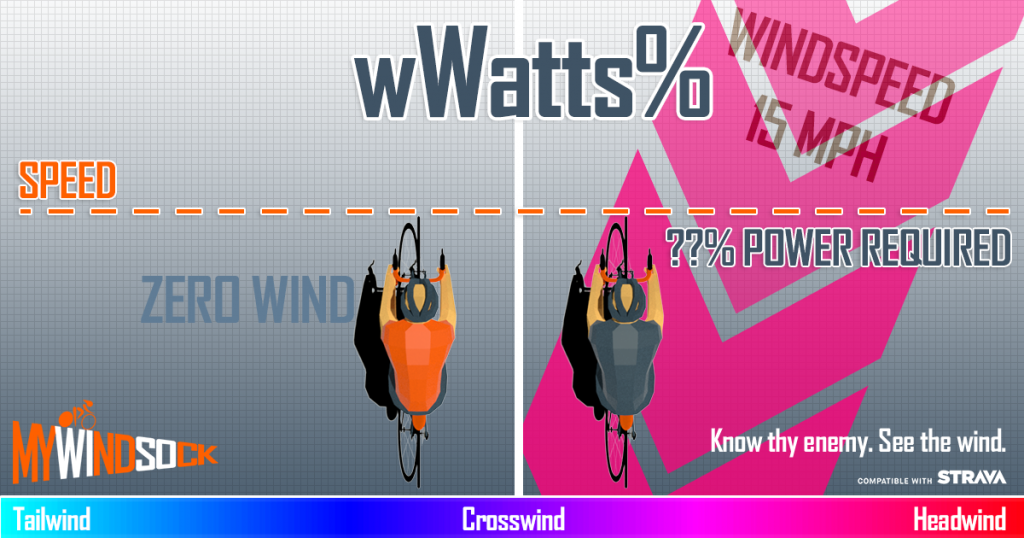
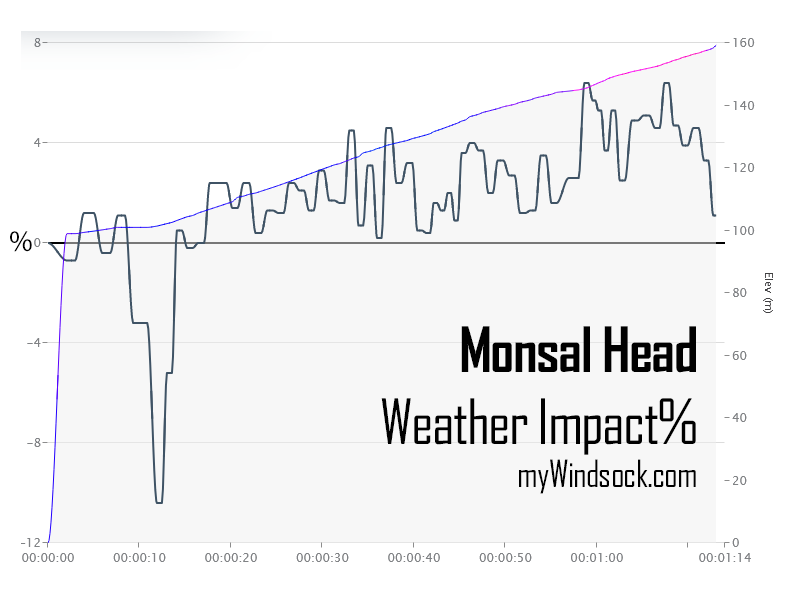
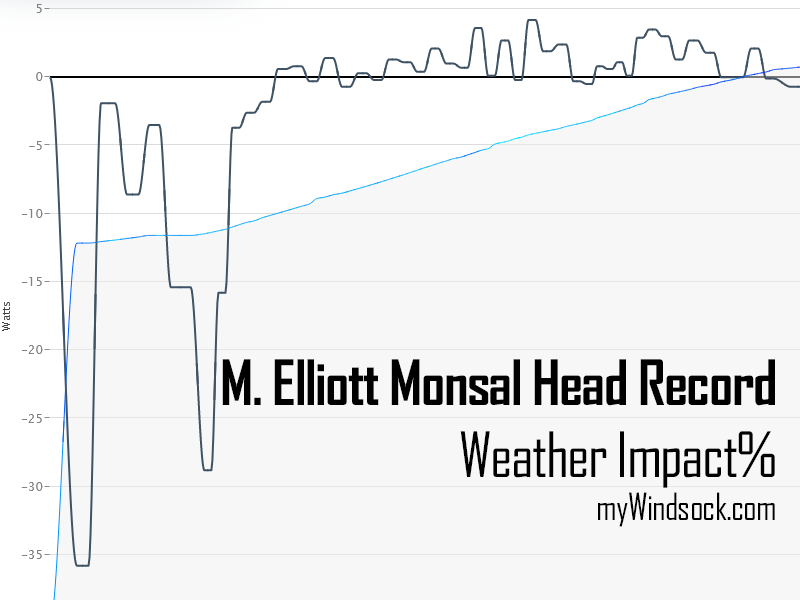
    Weather Impact% shows how much additional energy would be required to match the conditions of a weatherless day. Overall the wImpact% is 2.2%. This means to equal a weatherless day’s conditions, 2.2% more Watts would be required.

    11Watts/kg is 11Watts/kg, right? Wrong.

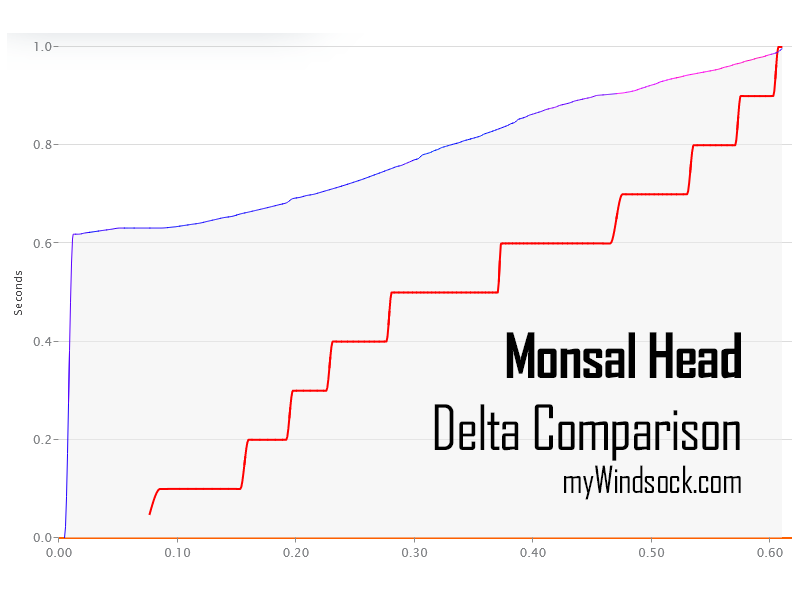
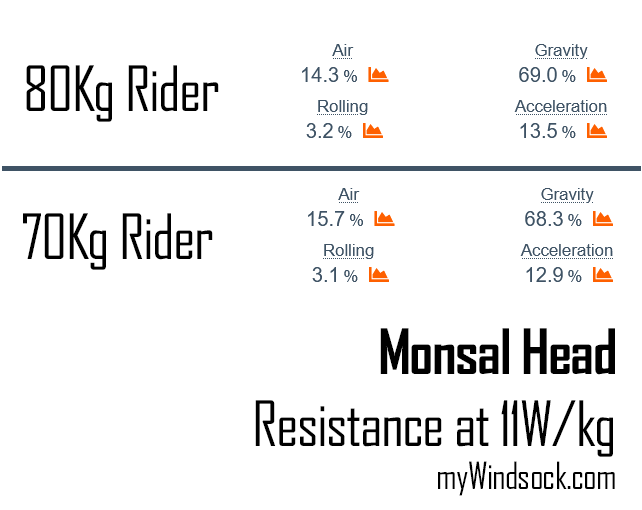
    On a climb like Monsal Head and the forecast weather conditions, a heavier rider with greater Watts, will better a ligheter rider who has the same 11Watts/kg required to hit the 1min 14.2Sec. The Delta Comparison Chart shows how the lighter rider loses time to the heavier rider.

    Red line shows 70kg rider losing time to 80kg rider. Eventually losing 1 second overall.

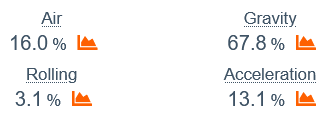
    Why is the lighter rider slower? Let’s compare the resistances.

    The lighter rider has a greater proportion of their energy overcoming Air resistance than the heavier rider. This is because, generally speaking, the aerodynamic drag does not increase proportionaly to the rider’s weight. The additional wind resistance will act in the heavier riders favour.

    So, how many extra Watts would a 70kg rider require to match the 80kg rider’s time?

    An extra 0.2Watts/kg (15Watts) would be required to match the time of the 80Kg Rider. Air resistance mostly consumes the additional Wattage.

    How good did Malcolm Elliott have it?

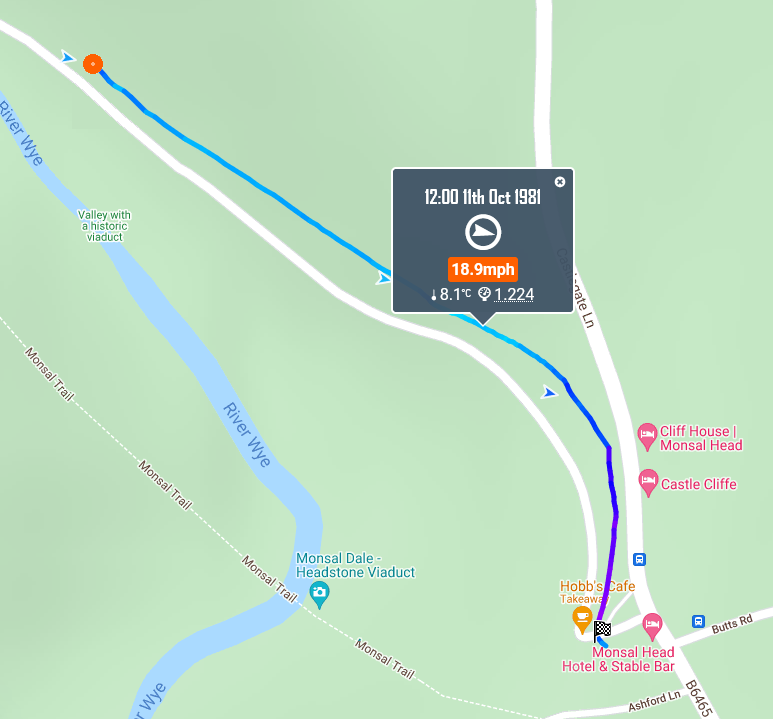
    Using myWindsock.com historic weather, we can look back to the recorded weather conditions for the 1981 Monsal Head Hill Climb.

    18.9mph WNW.
    Significant 8km/h reduction of air speed in first 45 seconds of ride.
    Overall the myWindsock Weather Impact% for 1981 was 0.1%. This is favourable compared to the 2.2% wImpact% forecast for Sunday.

    Big question, in 1981 what were the Watts/Kg required for an 80kg rider to record a 1min 14.2sec rider?

    10.44Watts/kg. But, big caveat… This was 1981, clothing, tyres and the bike would have been less favourable than today’s equivalents.

    Conclusion

    The current forecast is significantly less favourable to that of 1981. This will make a record ride even more exceptional should the 40 year old record fall.

    Check out the Monsal Head course yourself and make your own experiments.