
 UK Time Trial Events




When planning my week, I used to use my Apple weather app to decide which days I’ll ride inside vs outside yet increasingly, as winter turns to spring, I find myself sat on the turbo looking out the window at a sunny day. This is the result of weather forecasts being weighted toward pessimism. If you don’t pack your kagool on a day with a 40% chance of rain, you’ll blame the weather forecaster – if you pack it and don’t need it, you’ll think you got lucky. This asymmetry means the weather app is incentivised to tell you it’s going to rain, even when it might not.
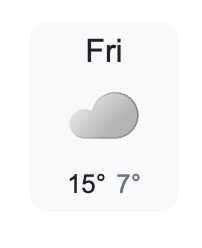
This is the season for moderate chances of rain, but your weather app will always tell you it’s definitely going to rain with those odds.
How do weather forecasts work, and why are they often wrong for cycling?
When you check the weather now, it’s easy to forget just how much machinery sits behind that little icon on your phone. It feels like a simple guess, sun, cloud or rain. In reality it’s built on a constant stream of data being gathered from all over the world. On the ground, weather stations quietly measure temperature, wind, and pressure throughout the day, many of them run by organisations like the Met Office. At the same time, weather balloons are drifting up through the atmosphere, sending back snapshots of conditions far above where we live.
Further out, satellites operated by groups such as NASA and the European Space Agency are watching entire weather systems unfold, tracking clouds as they build and move across continents and oceans. Closer to home, radar systems are scanning the skies to see exactly where rain is falling and how fast it’s approaching. Even planes and ships chip in, feeding back data from places that would otherwise be blank spots on the map.
All of this information is pulled together and fed into powerful computer models that try to simulate what the atmosphere will do next. These models don’t produce a single answer, they produce a range of possible outcomes, each with its own probability. That’s where the uncertainty creeps in, and where the forecast you see becomes less of a certainty and more of a carefully weighted judgement.
By the time it reaches your phone, what looks like a simple prediction is really the end result of a global system trying to make sense of an atmosphere that is constantly shifting and, at times, stubbornly unpredictable. Here’s the thing though, the weather apps are drawing conclusions from these models to help people get dressed for a morning on the high street, not for a 4 hour bike ride.
That’s ok though, because we have access to this weather data as well, and we put it all in one place for you…
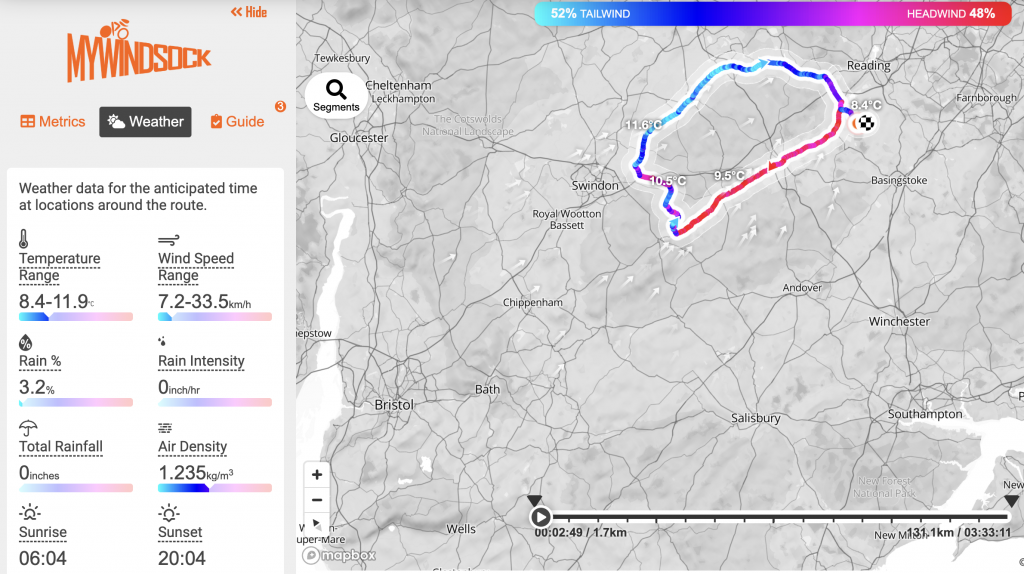
So, when you’re preparing for a ride or race, the Met Office app or Apple Weather isn’t going to cut it.
