
 UK Time Trial Events




If you’re allowed to share the work, why does a TTT feel so much harder than an individual time trial? This is, of course, dependent on the team. I’ve been in team time trials where I’m the strongest rider, and team time trials when I’ve been the weakest rider yet the hardest TTTs are always when you’re sharing the workload evenly. This is because, if you pace it right, you should come off the front of the group right on the limit of being able to get on the back, only then do you start recovering.
We can turn to academia for some insights as to why this is, though studying two or more riders in a line can be quite tricky (if you’ve ever been to a wind tunnel, you’ll know they’re not that big) so people who make these studies make these useful, but somewhat comical, little cycling figurines to make measurements.
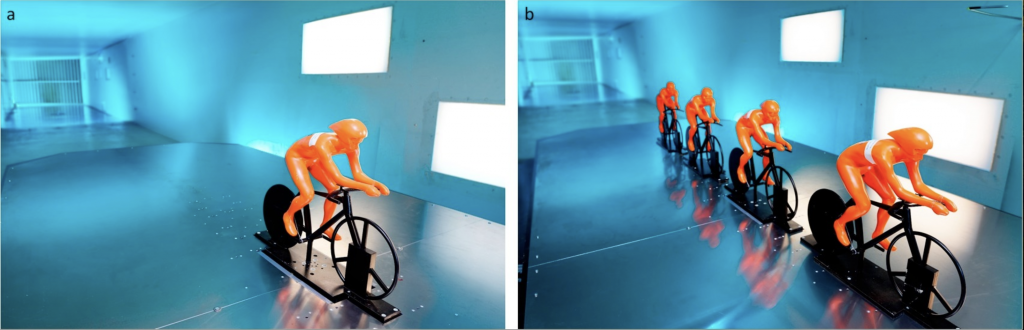
The study we’ll use to look into the physics of a TTT, in order to try and figure out why they’re so hard, looked into where in the line drag changes, the impact on spacing between riders as well as how the number of riders can make an impact. The cyclists in the study were scaled models of a 183cm tall with a bodyweight of 72kg.
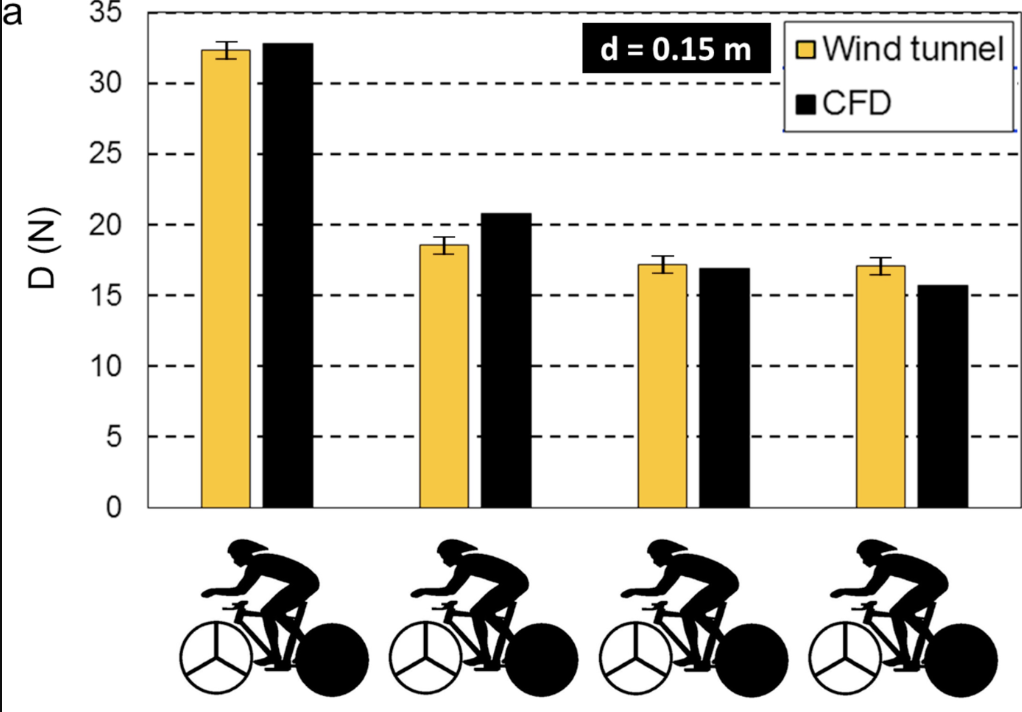
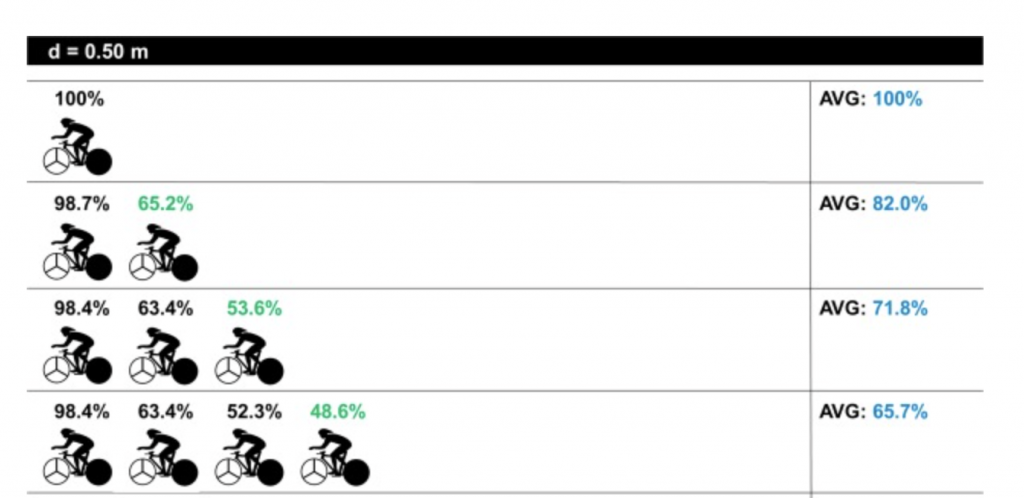
Those of you with a sharp eye will notice the rider at the front gets a slight reduction in drag force too. When two or more cyclists ride in a line, the front rider experiences a small reduction in aerodynamic drag because the riders behind slightly modify and stabilise the airflow in their wake, reducing the pressure difference behind them.
We know a rider in a 4-up TT experiences on average, 65.7% (let’s say 65% for simplicity from now) of the drag force and thus, their average cda over the ride is reduced by the same amount and, as such, they’ll travel at a much higher speed for less power. There are two moments during the TTT where every rider has to hold their speed or accelerate without any meaningful assistance though, while their on the front and while they’re drifting back.
In order to return to the back of the pace-line, it’s necessary for there to be a difference in speed between the rider peeling off and the rest of the group and that speed must be made up for with an acceleration in order to ‘get back on’ as the group passes. As you may remember from school, Isaac Newton’s second law tells us that the force required to produce an acceleration is proportional to the mass of the rider multiplied by that acceleration.
This acceleration is actually the reason team time trials feel so hard, this requires some depletion of a riders’ anaerobic capacity in order to produce enough power to make up that speed difference.
If you’re setting a forecast for your TTT, you can model how fast the team will go by using a cda that’s 65% (in the case of a 4-up TTT) of your usual value, so if your personal cda is 0.23 you can use 0.15 to calculate the speed that you might travel. If you agree the power you’ll ride on the front with your teammates beforehand, you’ll be able to use myWindsock to assess what’s possible.
