
 UK Time Trial Events




Every year, the heat becomes a bigger topic of the Tour de France than the year before. This year, it’s become such a problem that, friend of myWindsock, Victor Campenaerts has foregone his socks. France has always been pretty warm in July and heat has always been a problem at Le Tour, but it does feel like it’s starting to get dangerous with ever increasing temperature management protocols from participating teams.
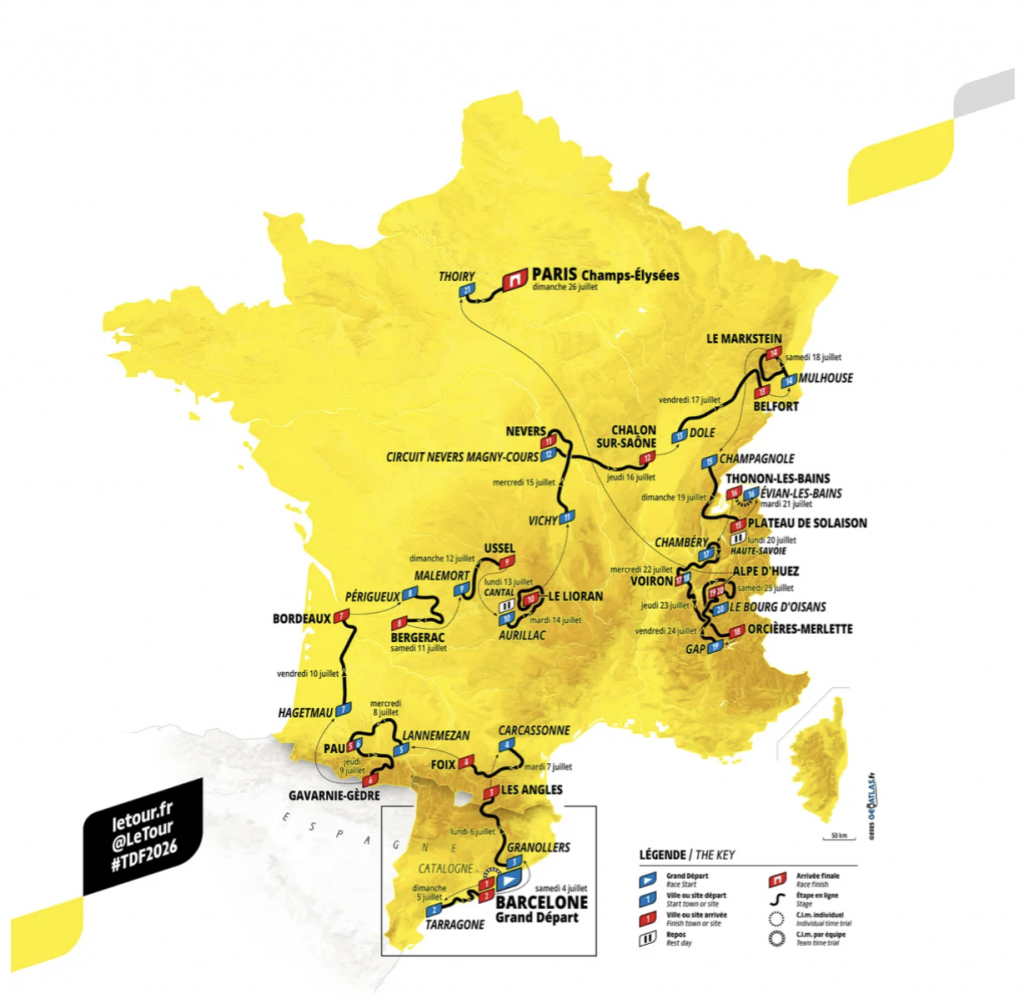
The other factor worth bearing in mind is that France is a massive country, at least in European terms. Every Brit can recognise the vast climactic differences between Scotland and Cornwall – if you drove this distance from Calais, you wouldn’t even reach Toulouse. If the Tour spends more time in the south these days, it may appear as if it’s getting hotter than it is in ‘real terms’.
We need to investigate if France is getting hotter as well as if the route is getting hotter too. For this, we will require a very specific set of skills and a slightly odd need to investigate such issues. If only there was some kind of website that would allow us to investigate this sort of thing…
Is France actually getting hotter in July?
France’s capital city is Paris, which in Summer can get quite warm and seeing as large urban populations typically have slightly more robust historical record keeping, we will use this as our initial benchmark. The data we’re using for this graph is from the French government and you can investigate it yourself if you like.
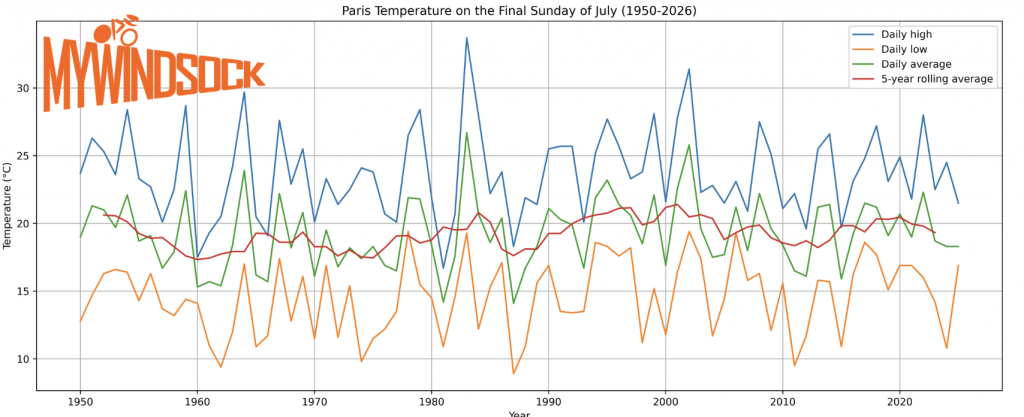
Since 1960 we see a slight upward trend of the daily average temperature with clear signals of heatwaves. Daily highs above 25 degrees have become more common and this has been felt more clearly since 2010. The microclimate of one city’s temperature gauge is not indicative of a broader pattern but if you were to ask the question of “are riders more likely to be sprinting up the Champs Elysees while warm today or in the past?” the answer would be that today is likely to be hotter.
Is the route getting hotter?
The below weather map is from France on the 12th of July 2026 in the afternoon. You can clearly see that the temperatures are distributed quite unevenly but there’s a rather warm patch in the middle. Le Tour actually went straight through this purple patch today and they shortened the stage by 30km as a result of this. It may be the case that routes have to be written with the temperature in mind in the future.
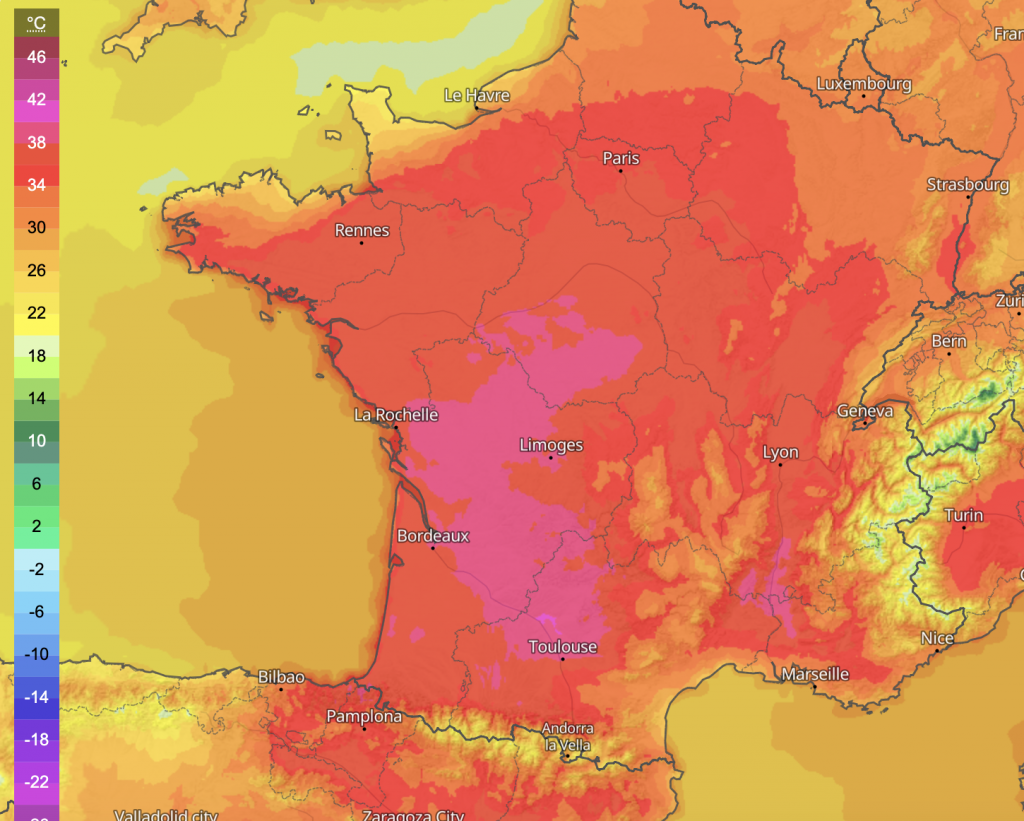
If we were planning the Tour de France, obviously we’d think about the weather first, seeing as that’s all we ever think about at myWindsock. This year, riders have been particularly unlucky in that they’ve been racing during a “heatwave”. Meteorologists typically declare a heatwave when daily maximum temperatures exceed a location’s specific average threshold for three or more consecutive days. As the average temperatures are drifting upward, heatwaves themselves are also getting hotter.
Certain parts of France’s geography are predisposed to heat and organisers should think about avoiding sending the race there in July. The final stage is an evening lap of Paris, which isn’t usually too hot especially as the riders don’t actually race it particTularly hard until the final hour of the race.
What should organisers actually do?
France is gradually warming up, along with the rest of Europe. Heat waves are becoming more common and they’re obviously both more likely and more severe in July. It seems that the position in the calendar is part of the problem, during the pandemic of 2020, organisers had no problem moving the race – ostensibly for the safety of the public and riders. A Wikipedia dive would show you that Le Tour has always taken place in July but there’s no obvious reason as to why that is.
It seems to me the organisers have two choices, one is to move the race to September or May while the other option is to stick to the edges, north and mountains of France and ditch the heat basin in the middle if they’re going to insist on the race continuing to take place in July.
The best way to plan the Tour de France would be with a myWindsock subscription. That way organisers could check historical temperature records along the route of each stage to make sure they’re not putting riders in danger.
