Tour de France Time Trial Preview

Today is the rest day of the Tour de France which has left us all sitting around and scratching our heads wondering what to do with ourselves. While I’m sure ITV and Eurosport are producing a glossy magazine show talking about some inspiring backstory surrounding Thibaut Pinot’s goats and Cycling Weekly are writing articles speculating around who feels good and who has shown ‘signs of weakness’ we decided to stay in our wheelhouse and talk about the impending time trial. 

This year, the Tour has only one TT and it’s pretty short in terms of distance but that doesn’t make it unimportant. Big gaps in the general classification are possible as the course is a tricky one to pace correctly and we will see slow average speeds (relative to the usual insanity in Grand Tour time trials).

The course 

The TT takes place on Stage 16 of the 2023 Tour de France and the course goes from Passy to Combloux. It has 3 climbs, the Côte de la Cascade de Cœur, the Côte de Domancy and the ride up to Combloux to finish. The descent from Passy Chef-Lieu down to Sallanches is technical and the roads are narrow (though have been freshly resurfaced).
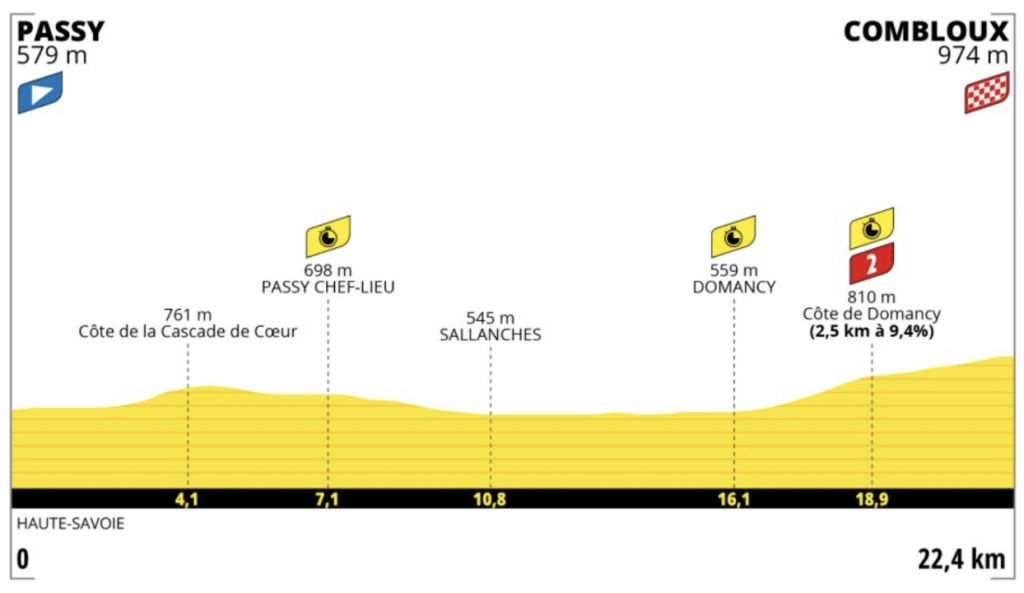
The parcours looks relatively flat, we can assure you that it isn’t.

The slower speeds in this climb will be interesting as will the high temperatures often seen in this valley. The teams that have invested in the materials that provide a balance between aerodynamic performance, cooling and also aerodynamic performance at slower speeds (as the fastest fabric at 60kph is not often also the fastest at 30kph) will have a competitive advantage over the riders wearing their standard speed suit. The usual disadvantage will also apply to athletes in the leaders jerseys as these skinsuits are typically slower than the team’s kit sponsor’s model.

The Weather Forecast

Due to Thunderstorms we are expecting very changeable conditions for the riders. Wind Speeds are expected to be predominantly South Westerly, at a Light Breeze of 6mph, with gusts of up to 27mph. The hot temperatures and intermittent showers will add to the complexity of the course.

On dry roads, a significant portion of the descent from Cote de la Cascade de Coeur towards Sallanches, could be taken in aero bars. However, the possibility of rain during the afternoon may cause riders to leave their fine tuned time trial positions more frequently. A wet vs dry descent is likely to be the greatest variable due to start time.
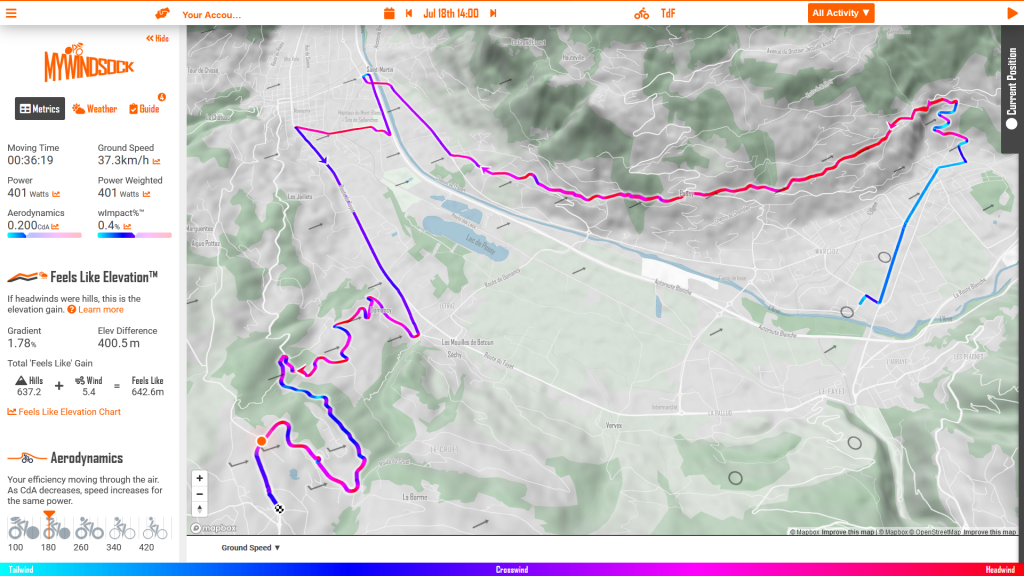
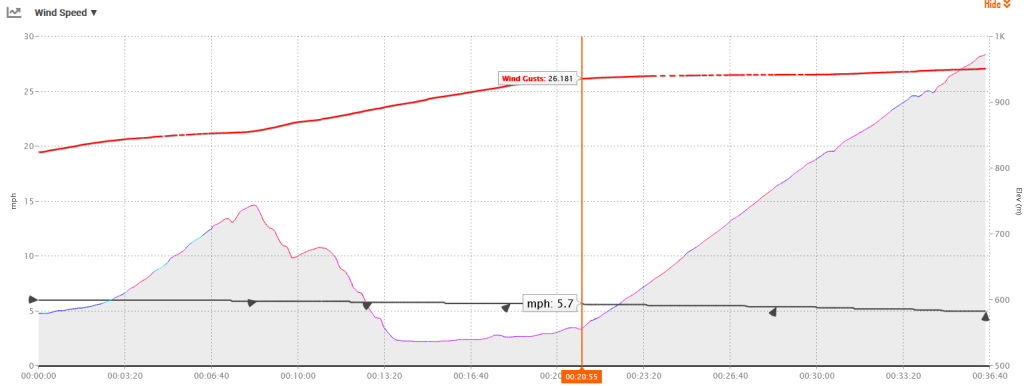
Changeable conditions with predominantly SW Wind.
Average Wind Speed Wind Gusts

Expected finish times

The best place to stay apprised of the conditions on race day is via our forecast which you can find here.

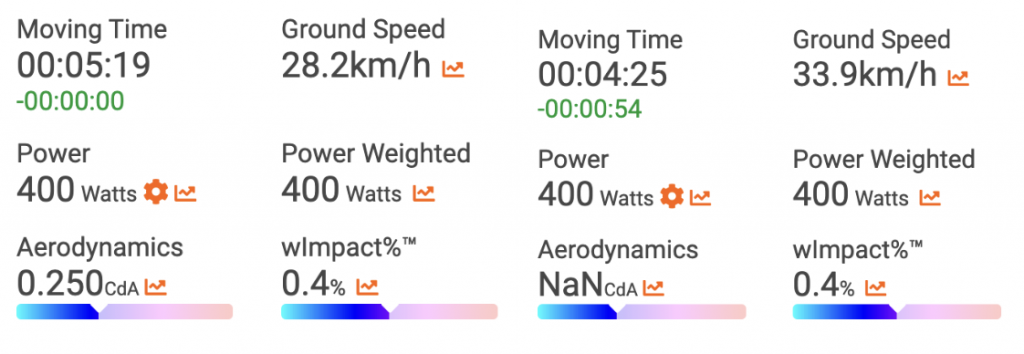
Over a course like this it can be difficult to predict finish times as the aerodynamic properties of riders change a lot on long shallow climbs. That said, the TT route is preloaded into myWindsock so we can check out the sort of times we might see based on a few power and weight options.  

For this kind of race, we will think of a TT specialist with a cda of 0.2 and 400W to play with, along with a system weight of 75kg then we will play with the settings to see what a rider like Pogacar – the favourite in my eyes – will do in this TT.
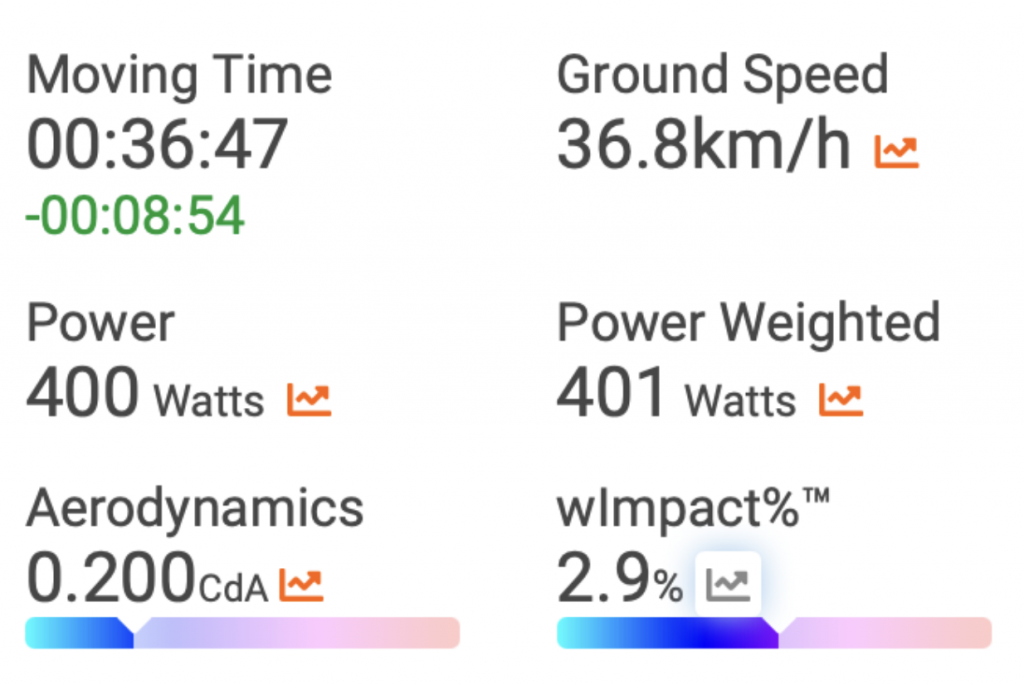
Run 1, the ‘average’ tour pro.

A solid benchmark for this first TT is under 37 minutes (weather pending of course). A GC contender will be able to do in the region of 6.1 W/kg for this duration and might have a slightly lower system weight of around 72kg. Let’s see what this does for the overall finishing time… 
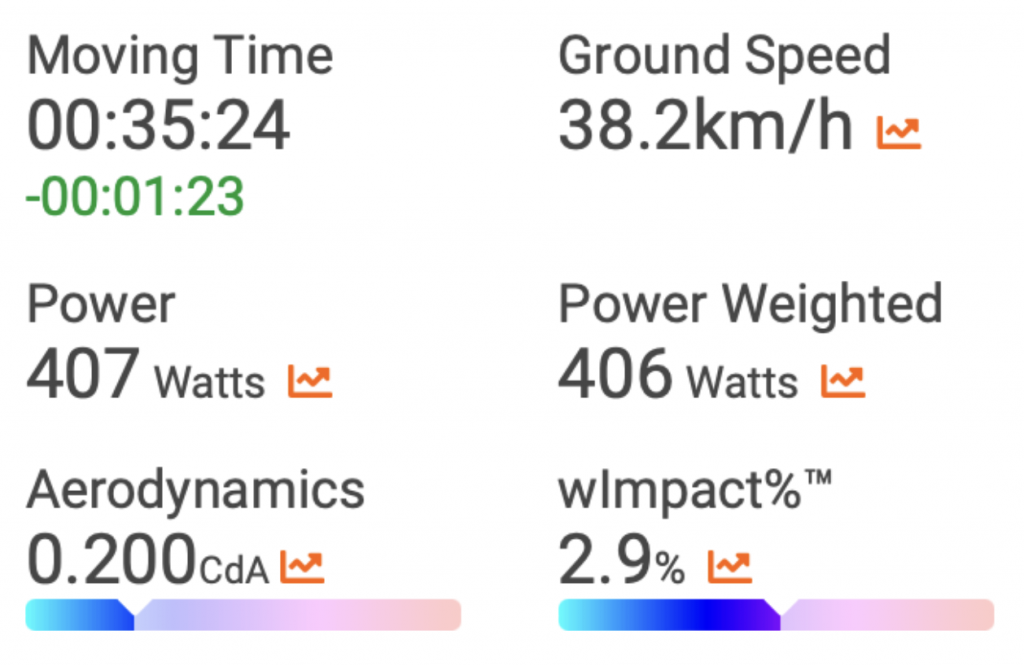
What might a GC contender do?

So the winner of the stage is likely to be pushing 35 minutes and it may come down to pacing strategy. This course also favours the lighter riders…
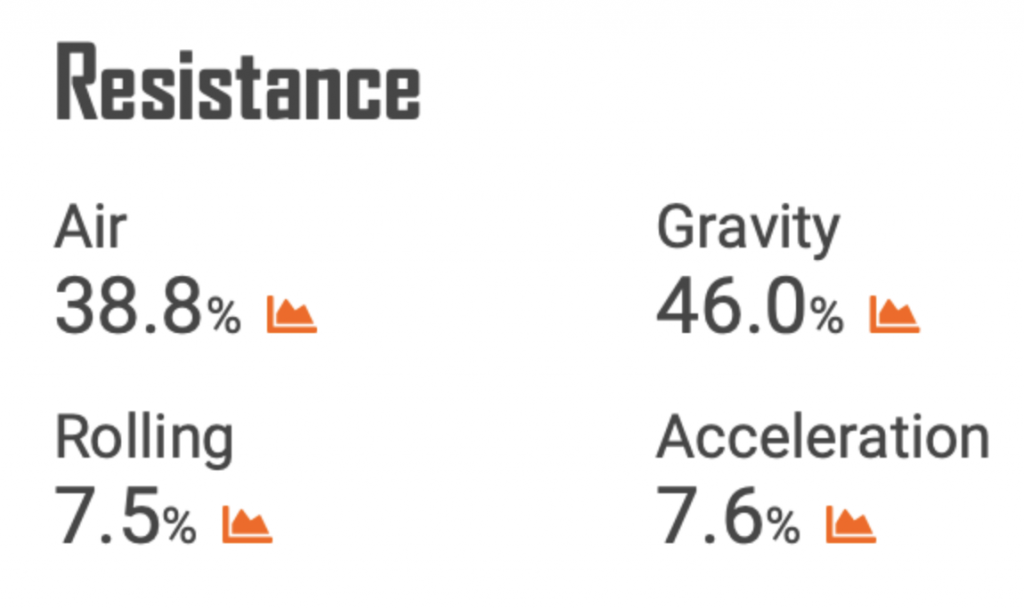
The force breakdown plot from myWindsock.

As you can see from our force breakdown, gravity plays a larger role than air resistance on this course – which is why I find myself frustrated when commentators describe it as ‘rolling’. This is a hilly TT that will suit climbers better. Yes the TT specialists will go better in the valley and yes the climbs are short, but the only bigger guy that stands any chance is Wout Van Aert.
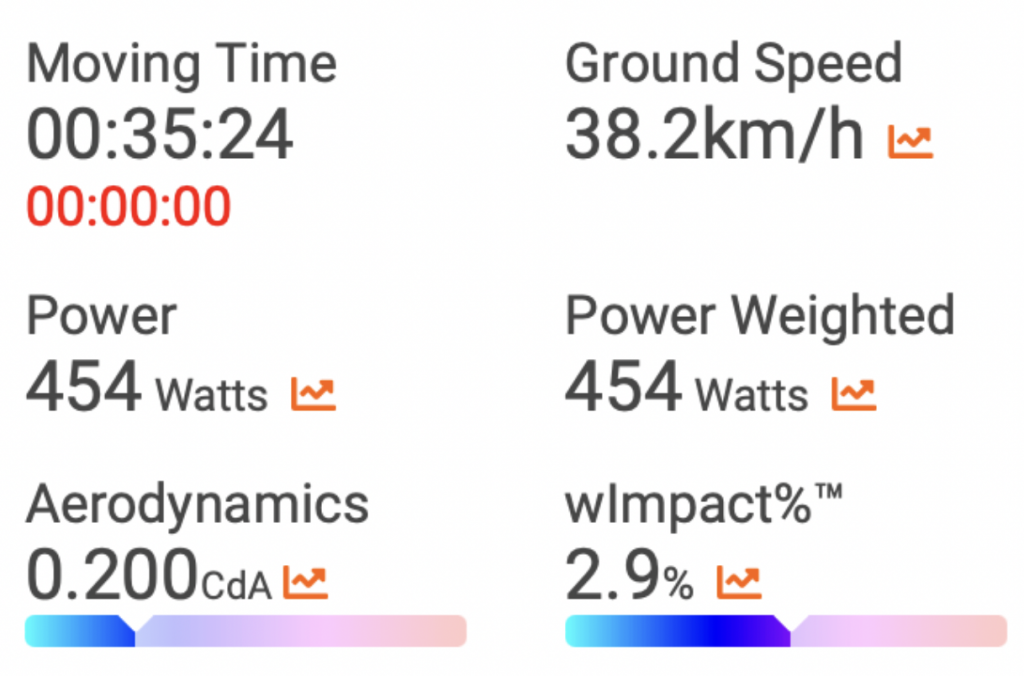
What can Wout do? This is a rough estimate of what he’d need to do to be competitive on the stage.

Winning is possible for Wout – as we can see above, but he’ll need to do some monster numbers and it will need a bad day from one of the other main contenders.

Blowing up on the last climb 

The last climb is steep and then turns out onto the main road where it flattens out to a low gradient for the final few kilometres. This low gradient section can be deadly though – it’s a big ring climb but it’s uphill all the way to the line. We thought we’d check out what happens if a rider cracks on this final segment by going too hard on the steep section – something we see often even in the pro peloton (think back to the final TT in 2021). 
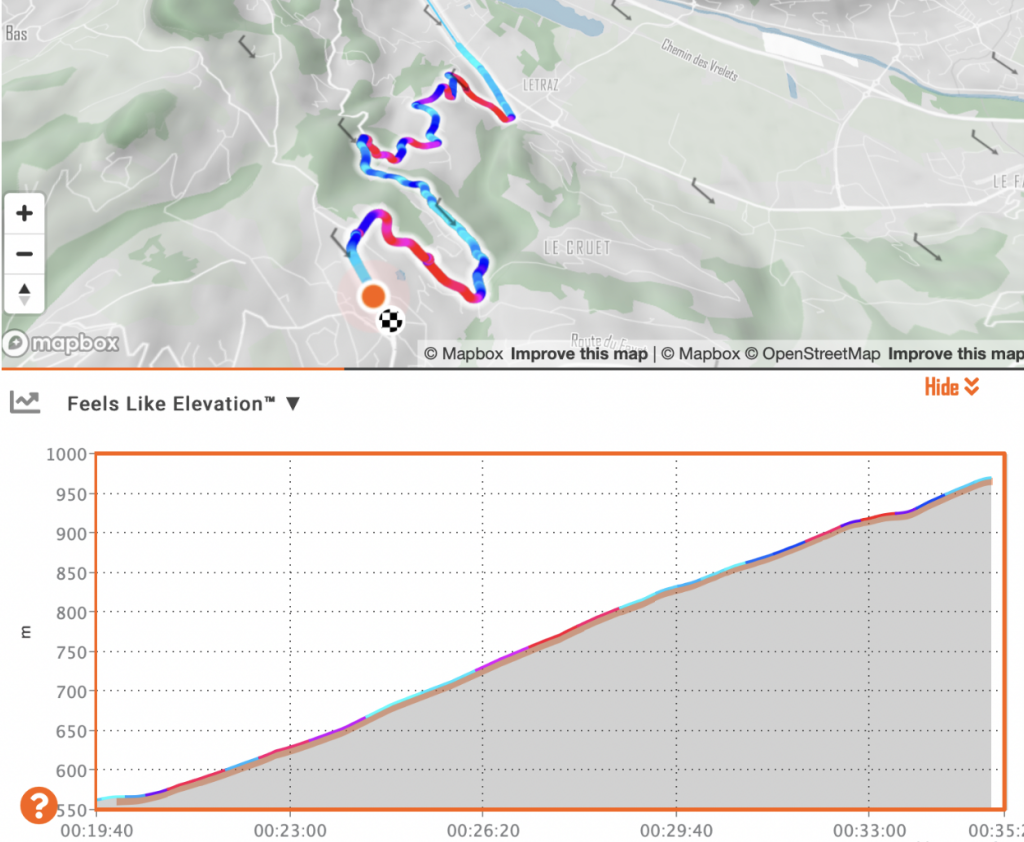
The final climb is tough with a 2.4km section over 10% average gradient.

The final climb is steep and will take riders around 15 minutes from the base to the top. The first 2.5 km is steep and the final km flattens out and goes onto a main road.

What happens if a rider blows up then?
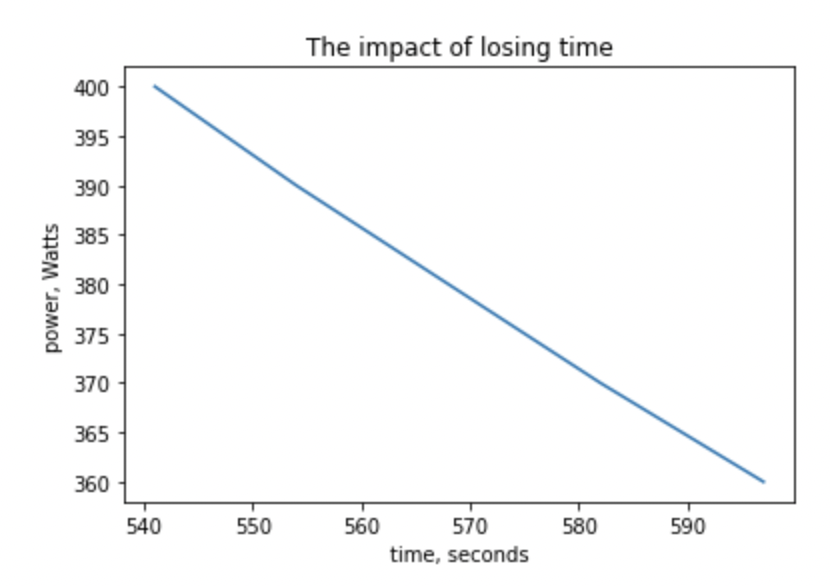
This plot shows what happens to a rider’s time as they drop off their power. On a climb it’s pretty linear, lose 10W and you’re shipping between 10 and 20 seconds on this climb. We will see some changes on the leaderboard between the final intermediate check and the finish with this parcours.

This TT is going to be important for GC but not long enough that it will decide the race. The overall winner is likely to be a GC contender but it could be won by a rouleur on a very good day. If you want to keep up to date on the conditions on the day, follow myWindsock on Instagram where we will be keeping up to date with the fastest conditions and providing live analysis of the time trial.


If you want to have a go yourself at predicting times and winners, or want to add a new level of precision and preparation to your riding – why not use myWindsock and sign up here.
Will there be echelons at the Tour de France today?

Probably not, but we thought people might google this. That said, we decided to have a proper look into it…

Echelons are exciting in professional cycling. Generally speaking, riders either love them or hate them. Crosswinds are a weird phenomenon as they can turn an innocuous piece of road into a very tricky section as riders in the wheel get no shelter if they’re in the wrong place. I find it can be a tricky concept to visualise but with a diagram (and the help of myWindsock) we can see when crosswinds might develop. Every year we see crosswinds in the classics season and the echelons occasionally pop up during grand tours. They’re exciting in grand tours particularly as GC time gaps can occur when they’re not expected. 

Predicting these crosswinds can be tricky. For example, crosswinds can happen but echelons do not form due to lack of motivation. Sometimes, a team tries to create echelons but the wind doesn’t blow hard enough or for long enough. Anything that relies on the behaviour of humans and the weather can be tough to predict – myWindsock is the perfect place to check whether the conditions are right but we can’t help what people do…

What should a rider do in crosswinds?

In crosswind conditions, road cyclists encounter additional drag and destabilising lateral forces. However, cyclists have found a way to minimise these forces by adjusting their spatial formation, forming an echelon. An echelon refers to a diagonal single pace line of riders positioned in a staggered manner across the road. This configuration is distinctly different from the formations used in wind-free conditions.

In a basic configuration with four riders at a yaw angle of 50 degrees, a rider positioned within the echelon experiences less than 30% of the drag faced by the rider at the rear, who is exposed to the crosswind. Adopting an echelon becomes advantageous only when the yaw angle exceeds 30 degrees. At this critical yaw angle, the drag on the rider at the rear doubles when the distance between the two groups increases from 10 cm to 1 m in real scale. Yaw angle is essentially the effective wind angle, so if you’re riding into a headwind the yaw angle is zero degrees and it increases as we move the wind direction around the rider.

When will crosswinds cause echelons?

An echelon is only worth being adopted when the yaw angle is above 30 degrees. Cross tail winds are also more effective for splitting the peloton as the effective draft in the wheels is lower and the speeds are higher (so gaps in distance open up faster). If the wind is blowing hard from an angle large enough, crosswinds have the potential for forming echelons.

Using myWindsock to predict crosswinds

At a shallow wind angle (in the direction of a headwind) the faster the bunch rides, the closer to zero the yaw angle gets. This means that any wind blowing in the direction of a rider’s hip round to their backside is what’s most likely to cause crosswinds. As, at the time of writing, the Tour de France is on, we will take stage 3 as a ‘crosswind potential stage’. To decide whether or not a crosswind will form echelons, we need to ask a couple of questions – what direction is the wind blowing? How long is the wind blowing for? How hard is it blowing? Who is motivated to make it happen? 

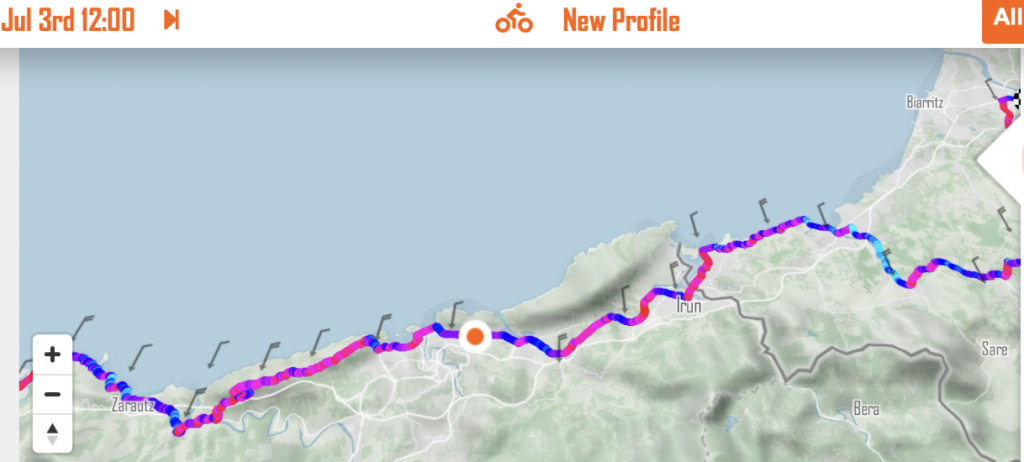
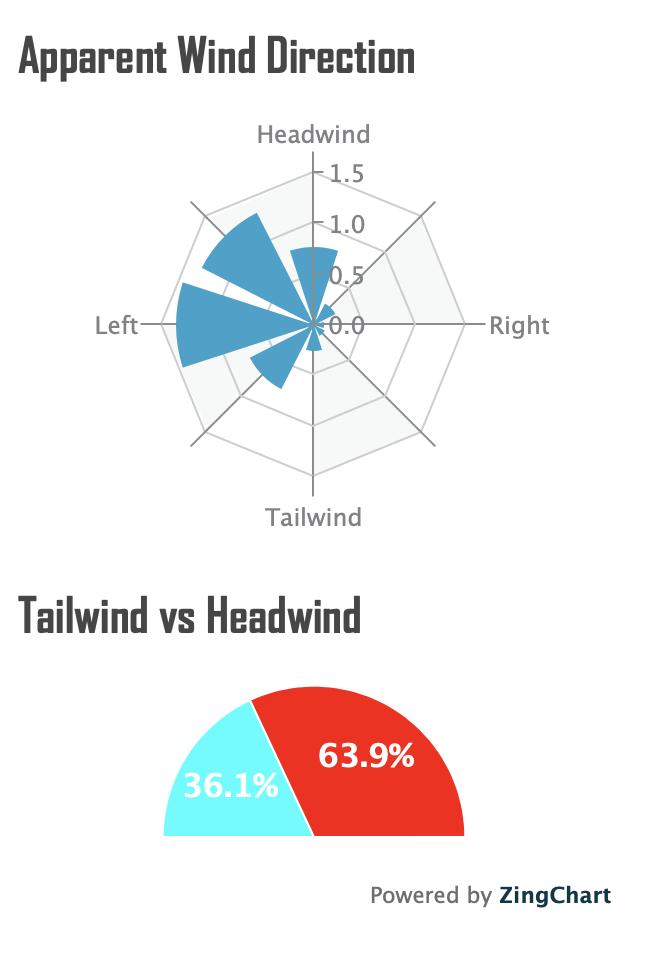
The first place to look is the distribution of tailwind to headwind and the directional breakdown of apparent wind direction. If it’s more tailwind than headwind and the majority of the wind is in the bottom left quadrant of the apparent wind direction graph – crosswinds are most likely to cause echelons. This breakdown is for stage 3 of the 2023 Tour de France where we can see that echelons are possible, but not likely.
The map is also an excellent place to check where crosswinds might cause splits and echelons to form. If echelons do form during this stage, it’ll be just before they turn in land toward the finish but it will require two or three motivated teams to do so as the section of cross tail wind is relatively short.

To us, crosswinds will blow in this stage but it’s unlikely to cause too much grief. GC teams will want to pay close attention as the race turns in land toward the finish where conditions are optimal for someone to try something as the wind is in the right direction and the distance to the finish is small enough that it’s not obscene to pace all the way to the line from there.

We know that myWindsock is used in many a team bus in the World Tour – so if you’ve got a bunch race coming up in a windy place (or just want to stick it to your clubmates when they don’t expect it) check out myWindsock and sign up here.
National Criterium Championships 2023

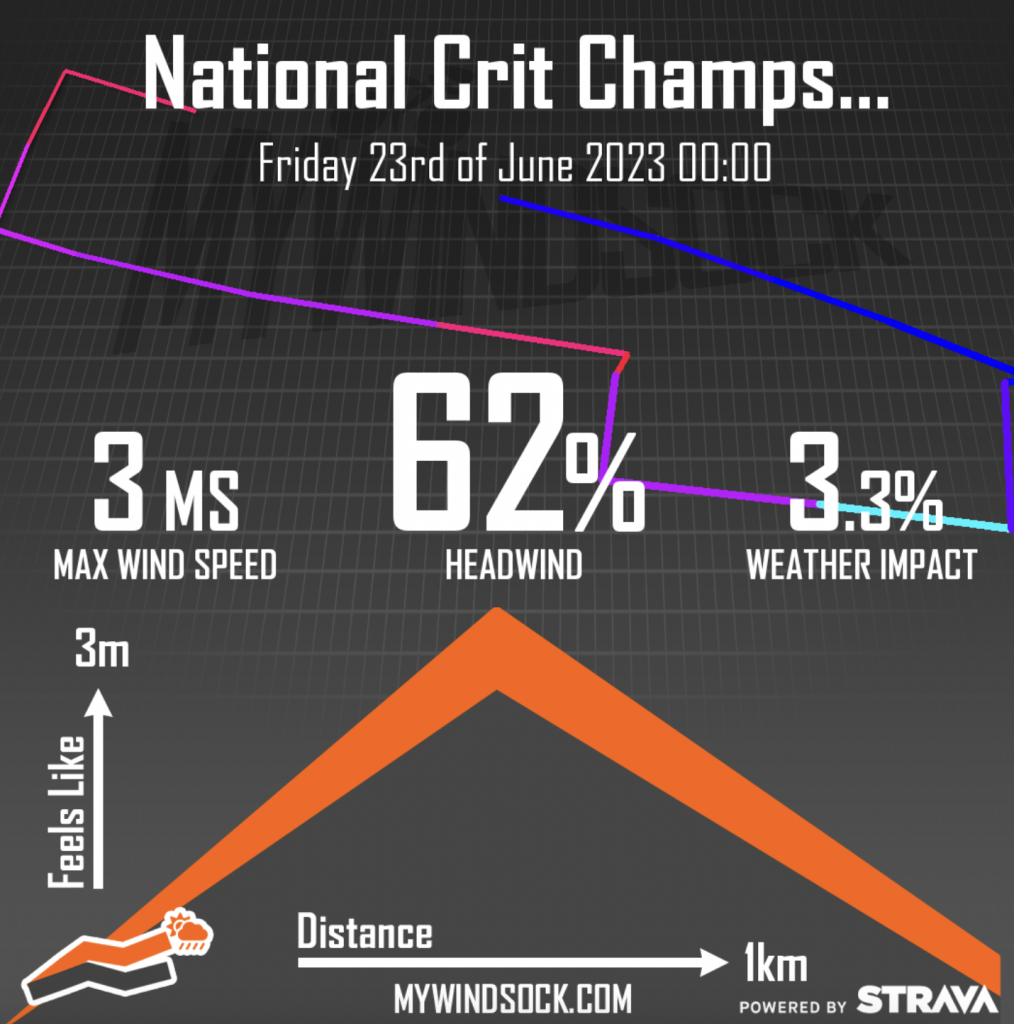
I know you all thought that myWindsock was just for time trialists – well, you’re wrong. As you might be aware, there’s the small matter of a couple of races which will decide the British National Championships this coming weekend and we thought it would be interesting to have a look at the criterium course – a 1km lap where small differences in positioning and power distribution can make outsized changes to the race result. 

Mark your calendars for an exhilarating spectacle on Friday, June 23rd, as the enchanting coastal town of Redcar sets the stage for captivating circuit races. The racecourse itself spans a scenic 1km, boasting a well-deserved reputation for its intricate turns and demanding technical elements. Riders will kick off from the lively seafront, navigating their way through the bustling high street then back onto the shore front road. Prepare for an adrenaline-fuelled showdown as both the men’s and women’s races unfold, battling fiercely for 55 minutes, along with an additional five laps.

The 1km circuit boasts a total of six corners, all left handers and all relatively fast – with no hairpins or turnarounds meaning this is likely to resemble an American style criterium rather than the slightly slower traditional town centre crits in the UK. Barrier placement will play a role in how these corners are ridden but for the experienced men and women on the start line – they’ll likely still be fast. 

The weather

Two factors go into a seafront crit in the north of England – one being the wind, the other is the rain. At the time of writing, we aren’t expecting rain for either race which is good news for the riders involved – the roads are relatively wide town centre roads with two lanes – these have a lot of white lines on them so the potential for slipping in the wet is very high.  

Secondly, a strong wind off the seafront could cause the race to blow apart early – thankfully for some of the riders, the wind is coming from the other direction meaning they’ll be sheltered from it.

If you’d like to check the forecast out for yourself – you can do so by clicking on this image.

The interesting thing about this course is the distance from the final corner to the finish line – it’s quite big. This means riders won’t want to enter the final corner too far up the bunch or they’ll find themselves getting rolled on the line. They will have a sheltered slight cross tail (but majority cross) wind. If I was a betting man, I’d expect the winner to come from between 8 and 10 wheels back coming up the sea-facing side of the road. 


If you want to race with confidence that you’ve got the best information at your disposal like riders in World Tour races and Olympic Medallists – you should do so with myWindsock by clicking here.

How to take the Box Hill KOM

Box Hill, an esteemed name cherished by cyclists, resonates with profound significance. It transcends being a mere hill, evolving into a symphony of emotions, an exhilarating ballet embodying the fusion of man and machine, an awe-inspiring testament to the unyielding human spirit. Memories immediately turn to the London 2012 Olympics as the GB team train powered up there with reigning Tour de France champion Wiggins guiding Cav for a glorious sprint – which didn’t quite work out. 

Approaching Box Hill, cyclists experience a surge of anticipation, their hearts racing in sync with the winding road ahead. It unfurls like a clandestine pathway to a cycling utopia, beckoning them to embark upon its mystical 5% gradient. Legs tense and  muscles poised. The surrounding world dissipates into the periphery, and their focus narrows upon the rhythmic symbiosis between body and bicycle. The symphony of their breath intertwines harmoniously with the whirring of the chain, and the steady cadence of their heartbeat morphs into a metronome of unwavering determination.

The apex of Box Hill unveils a panoramic vista that steals their breath away, a well-deserved reward for their gargantuan effort. Boundless horizons of undulating hills sprawl before them, an intricately woven tapestry of limitless possibilities. In that singular moment, every ache, every drop of sweat, and every ounce of effort finds profound purpose… as your ride uploads to Strava and Rory Townsend gets an email saying someone has just nicked his KOM.

Our tips on sending Rory Townsend an email

Box Hill means a lot to cyclists in the UK – not as much as it used to but the KOM is still a big one. All Strava nerds know who holds it and we are going to advise you on how you might go about trying to take it with the help of myWindsock.

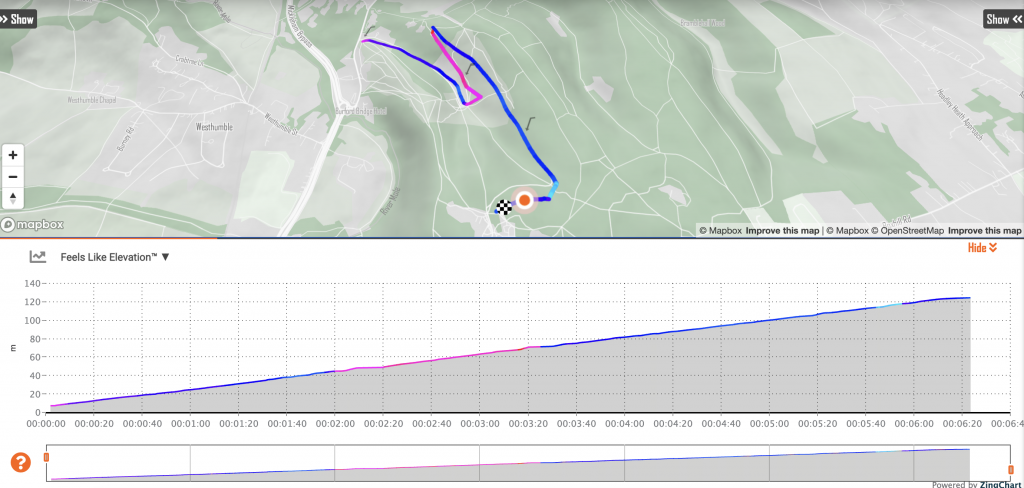
This 3D veloviewer map allows us to visualise how the segment of box hill will play out when we ride it.

As I’m sure you can imagine, there’s a large number of segments on Box Hill but this map gives us a good idea of the main features of the climb – namely that it’s not particularly steep. This means aerodynamics plays a large role. Box Hill is a particularly interesting segment as pretty much all forces play a significant role in slowing you down (whereas usually either weight or aerodynamics are overwhelmingly dominant). 

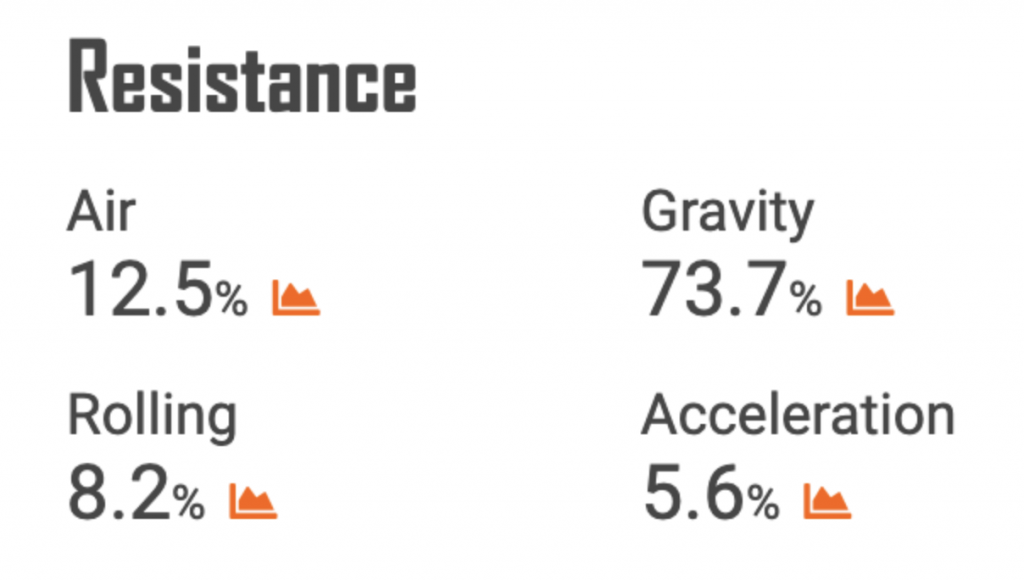
We are still going up a climb, however, so as you can see gravity is the strongest resistive force. The rolling resistance and air resistance make up over 20% of what is slowing us down; however, this means that for every 100W we put through the pedals, 20W isn’t doing work against gravity. 

The elevation gain on this segment is 118m which means we need to do 92575J of work against gravity to get to the top and there’s nothing we can do about this. In order to reduce the amount of energy lost to the other resistive forces, we have three main strategies…

  1. Drafting – if you’re behind something big enough, air resistance can be practically zero. I recommend a car with the boot open in front and a van behind. Obviously, if you do decide to take this route, don’t do it on a busy day…
This shows us the huge difference that drafting can make. By sitting between two relatively large vehicles a rider could get their aerodynamic resistance relatively close to zero. It’s been measured that a rider in the middle of a peloton faces around 5% of the air resistance a rider on the front would face – so it’s not too different from that, possibly a tad more dangerous.

In reality, you won’t be able to get your cda down to zero but you probably can get pretty close if you’re willing to risk your life. For a rider (and bike) that weighs 80kg doing 400W, removing air resistance is enough to take the KOM. 

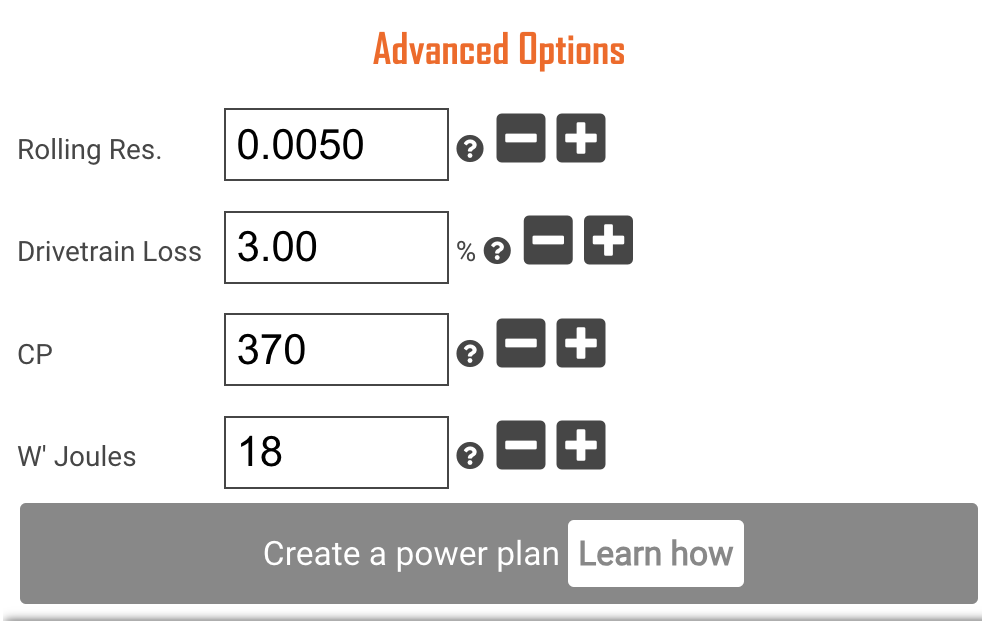
2. Fast tyres – using myWindsock’s advanced settings we can change the rolling resistance and drivetrain losses. Imagining we’ve splashed out on all the latest tech and halved our rolling resistance and dropped our drivetrain losses by half a percent, we can save ourselves 13s.

3. Weight loss – it’s likely that we won’t be able to lose weight ourselves, but let’s imagine we are a 70kg rider with 6kg of extra baggage (bike, clothes, shoes and such) so we can drop our system weight down to 76kg from 80kg. This is another 12s saved.

Overall this trickery has taken our time down to 4 minutes dead. The KOM is currently at 4:32 so if you want to take the box hill kom and don’t have many watts, simply cheat and buy very posh bike parts. 

If you want to know how much difference various factors make on your own personal segment bashing quests, sign up to myWindsock here.

myWindsock’s advanced settings

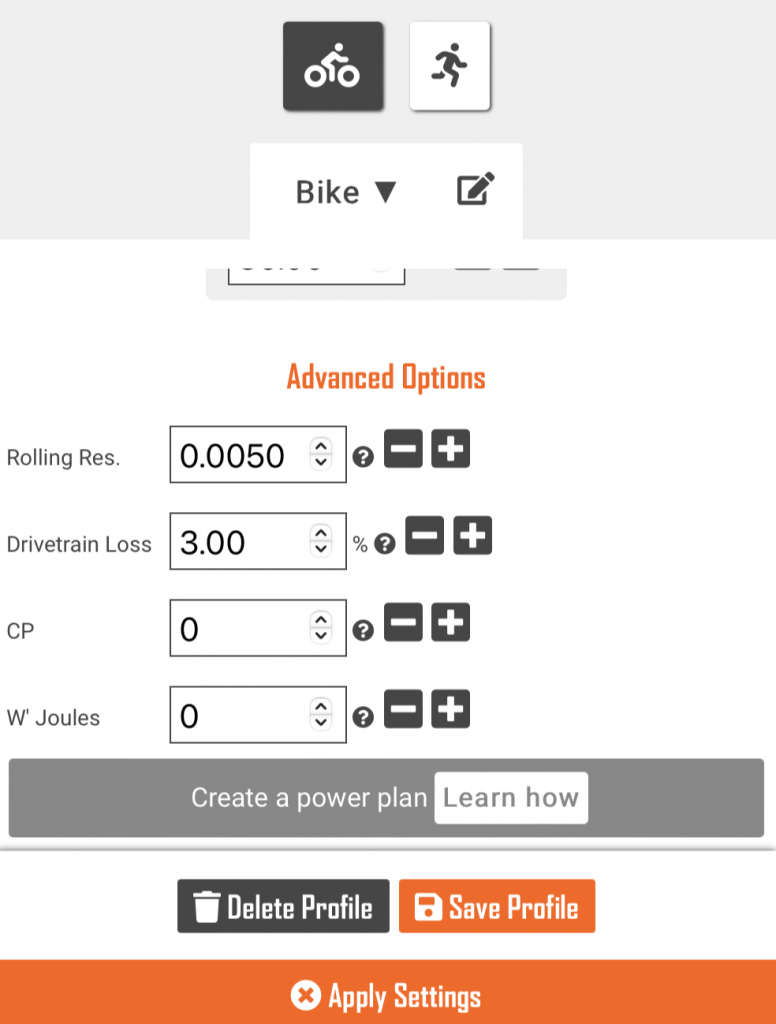
When you’re setting up a forecast in order to analyse a course on myWindsock, there are a couple of things you can do in order to make it a touch more accurate as well as model the difference that equipment choices might make and calculate a pacing plan. Rolling resistance, drivetrain efficiency and a number of other things can impact the accuracy of a forecast and many of these assumptions can be tightened using our advanced settings.

Let’s check out a forecast… 

From the main page of the forecast, scroll down the margin on the left until you get to the bottom…

Click change settings, scroll to the bottom of the pop up and hit ‘Advanced Options’

From here you are able to set a number of options that can impact the overall time of your forecast. Let’s check out the rolling resistance feature…

How does a change in rolling resistance impact the overall time in an Ironman? 

Let’s, for example, imagine we want to ride an Ironman bike split under 5 hours, that’s pretty good going for most amateur athletes. We are at Ironman Texas and are able to hold an average power of around 210W with a cda just over 0.25. These sort of numbers are typically what you might find in an amateur Ironman field. Our rolling resistance coefficient is set to 0.005, this is typical of what you might find in a training tyre – but what if we change rubber?

Rolling resistance – typical values and what to buy?

Helpfully, Aerocoach have compiled a list of rolling resistance data here which you’re able to see how various tyres performed on their test. Databases like this are how I decide which tyres to buy, but beware – there’s a payoff between puncture protection and rolling resistance! 

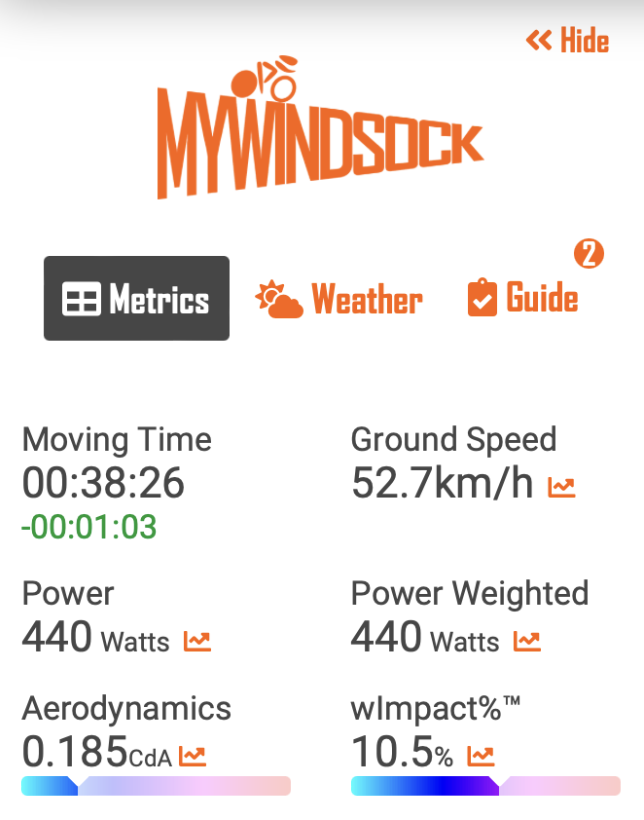
If we move from a tyre with a crr of 0.005 to something like a GP5000 TT, which Aerocoach measured at 0.002216 for their tubeless version, how much time do we save on our Ironman from the original 5 hours, 1 minute and 38 seconds? This is a saving of around 30W which equates to a whopping 13 minutes and 55 seconds – that’s huge!


If you want to model your next race, training ride or KOM you can check out myWindsock here.

National Circuit Championships Course Analysis

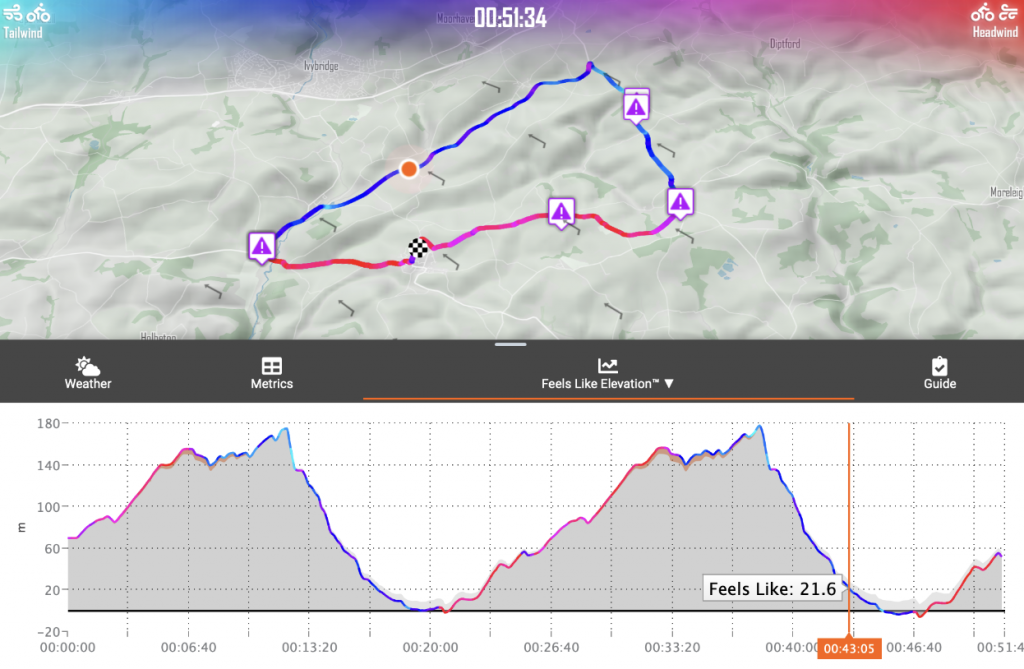
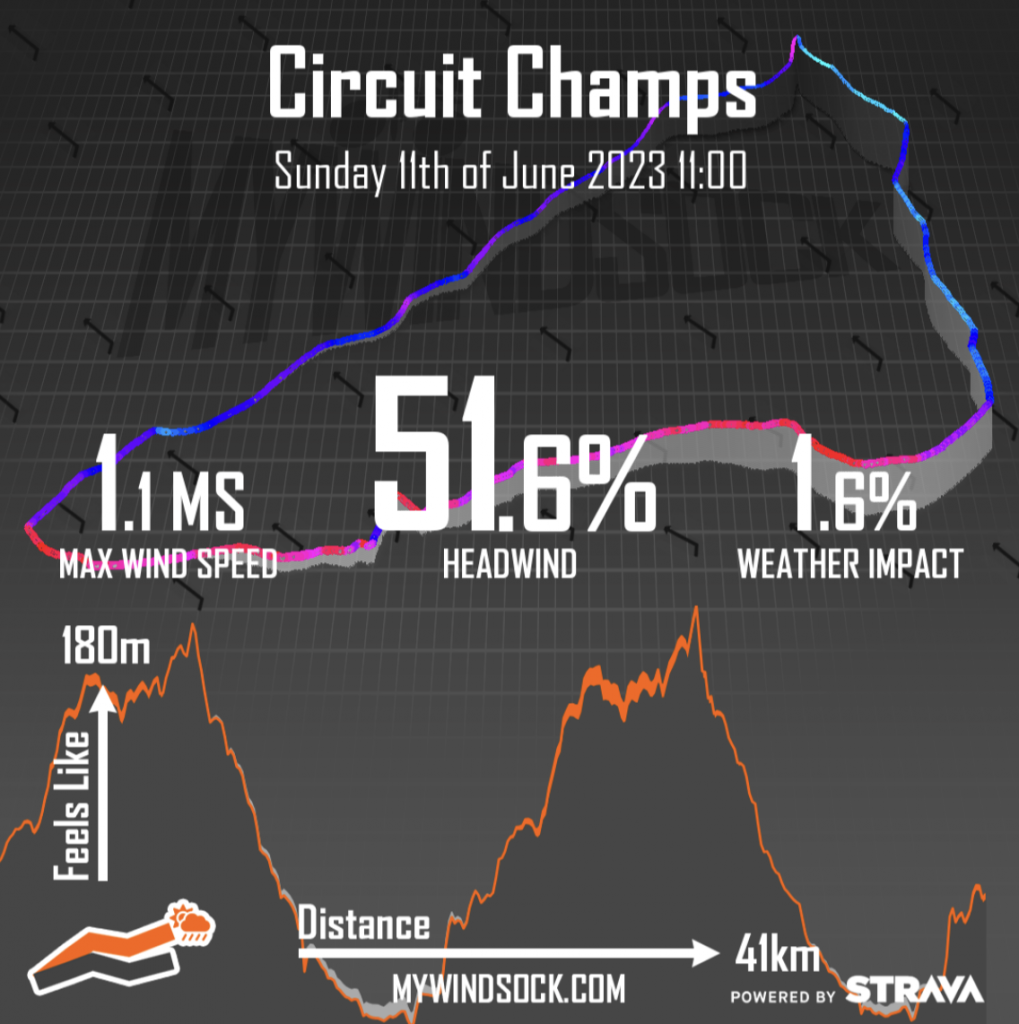
On the 11th of June 2023, CTT’s national circuit championships are going to take place on the S3/25S(A) course in Devon. This is a rolling, technically challenging circuit where pacing and the weather will likely play a large role.


The course has around 240 m of elevation per lap and there are two laps. The danger of this course is in the first climb, riders that start too hard will blow their legs off for the remainder of the race and riders that don’t warm up properly will find themselves shipping unrecoverable amounts of time on the first ascent. The long descent each lap is usually tail wind or cross tail wind and will require riders at the pointy end of the field to be brave – facing very high speeds and those who remain in the aero bars will gain time on riders that have to sit up. 


myWindsock forecast and course breakdown.

The forecast for the course can be seen here – where you can interrogate all key features of the course yourself. We have decided to focus on a few key elements here, namely the steep portion of the climb and the descent.

The Climb

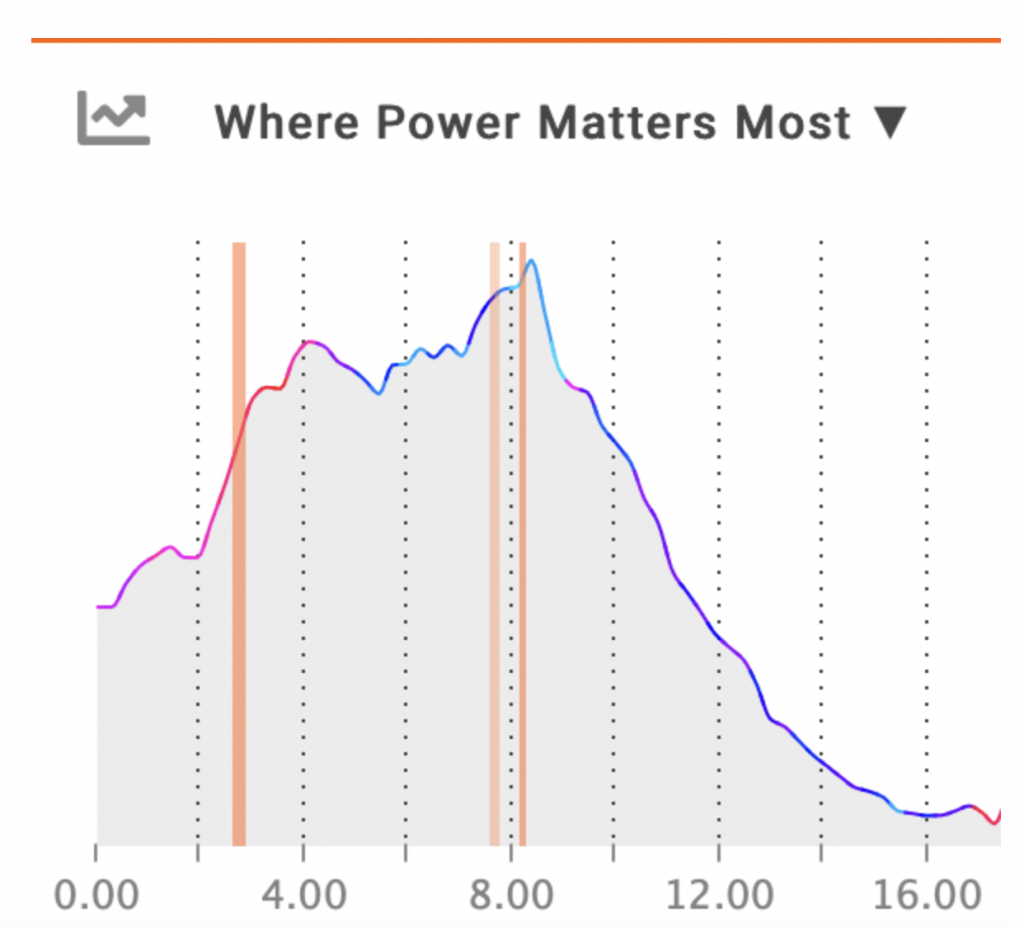
Using myWindsock we can run an experiment which will locate portions on the course where power matters the most. These are the portions of the course where a rider will be moving slowly. There are three portions on this course, the largest of which is on the steep section of the climb. 

Where Power Matters: A numerical experiment on myWindsock which allows us to show the points on the course where we need to go very hard.

The descent

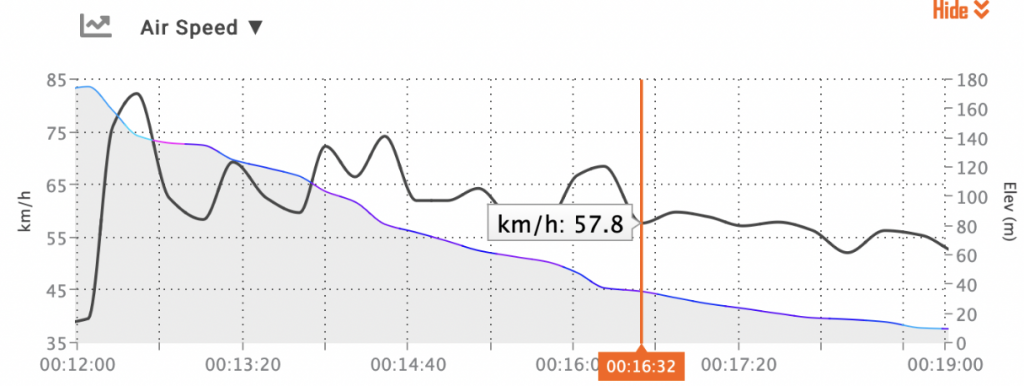
Speeds get high on the descent, riders will want to get as aerodynamic as possible. At points, riders will approach 85 km/h air speeds, which with a tailwind could mean ground speeds of around 90 km/h – the top riders will be going FAST!


How can I use myWindsock to pace my effort?

Using myWindsock to pace a time trial can be a valuable tool in optimising your performance. Here’s a step-by-step guide on how to use myWindsock for pacing:

  1. Sign up and log in: Visit the myWindsock website and create an account or log in if you already have one.
  2. Set up your time trial: Enter the specific details of your time trial course as well as your personal numbers like power and cda. This information will help myWindsock generate accurate predictions and recommendations.
  3. Plan your pacing strategy: Based on the wind data, identify sections of the course where you will face headwinds or tailwinds. Adjust your pacing strategy accordingly.

Pacing a rolling course like this one can be tricky but it essentially boils down to a few factors. Climb hard, but not too hard, punch over the top and recover on the descents. That said, a little planning never hurts in a time trial and if you want to plan with the best in the business as used by World Tour riders and Olympic champions – click here to sign up

How the Giro was lost: A lesson in how not to pace a time trial

Yesterday, British hopes were dashed as Geraint Thomas blew up in the last 2k of the Giro d’Italia. This led to a lesson for all of us – leave something in the tank for a TT with a hill at the end.

What happened in the race?

In a thrilling penultimate stage mountain time trial at the 2023 Giro d’Italia, Primož Roglič defied a mechanical setback to emerge victorious and claim the pink jersey from Geraint Thomas of Ineos Grenadiers.

Despite facing a setback when his chain slipped due to a pothole during the climb, Roglič demonstrated remarkable composure and accelerated through the remainder of the ascent. He not only managed to recover but also outperformed Thomas by an impressive 40-second margin, securing the stage win.

With only one ceremonial stage remaining in Rome tomorrow, Roglič’s triumph in this stage virtually guarantees his overall victory in the race. Despite being the second fastest rider on the day, Thomas relinquishes the pink jersey that he had held for a significant portion of the competition, falling short at the final hurdle.

During the stage, Primož Roglič received an immense amount of support from a large contingent of Slovenian fans. They crossed the nearby border to cheer him on, proudly waving their nation’s flag adorned in blue, white, and red. The fans passionately chanted Roglič’s name, providing him with an extra boost of motivation and energy.

Expressing his gratitude at the finish, Roglič acknowledged the tremendous impact of the crowd support. He attributed his success partly to the enthusiastic fans, stating, “I had the legs, and the people they gave me extra watts.”

However, while Roglič basked in his triumph, his victory came at the expense of Geraint Thomas. Thomas had appeared poised to secure the overall victory and potentially become the oldest champion in Giro history. Unfortunately for Thomas, Roglič’s glory meant a sudden reversal of fortune, transforming his anticipated triumph into a heartbreaking disappointment.

Pacing a TT with a climb at the end

Everyone reading this knows that to pace a TT with a climb at the end you need to distribute your energy differently to how you might pace a totally flat time trial. We saw a little bit of this on stage one of the race but the climb was not as severe as the one the riders faced in the final TT.

Essentially, Thomas ran out of gas and it’s likely he would not have lost as much time if he’d have paced the flatter portion at the start a little more sensibly. To get a more concrete example of this, we will head into myWindsock – where all the stages from UCI races can be analysed by premium users.

An exaggerated example:

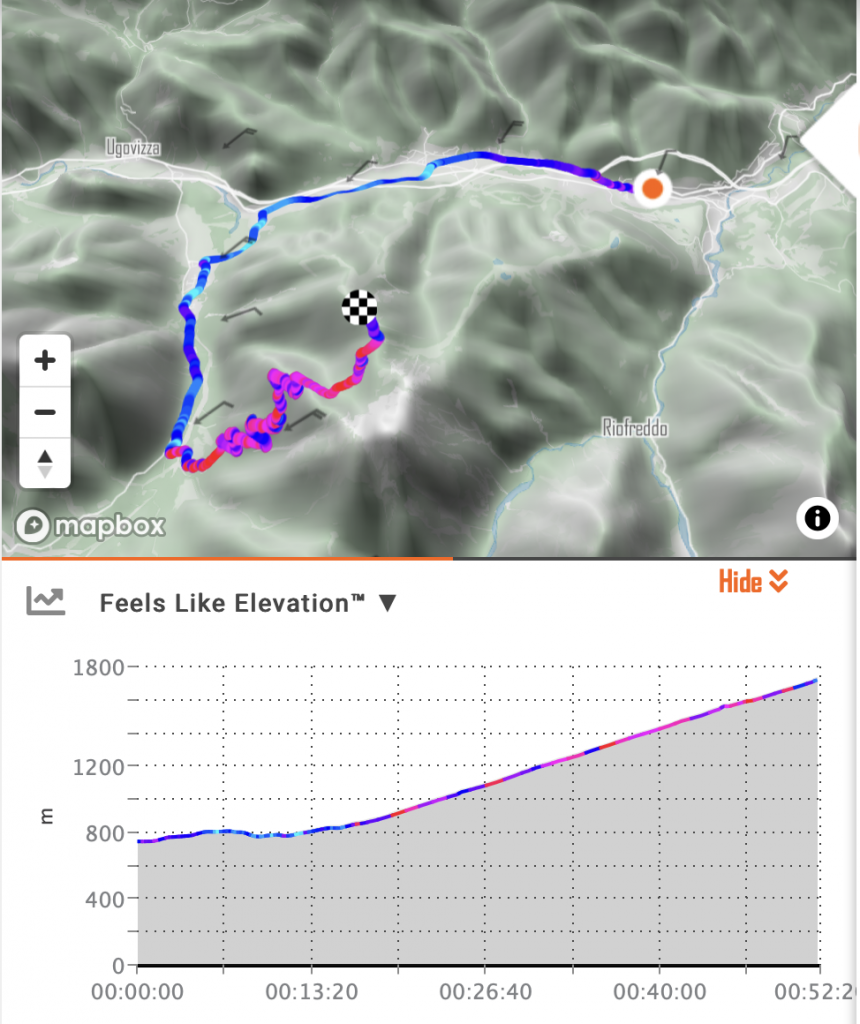
Stage 20 of the Giro provides a perfect example of an exaggerated TT with a hill at the end, there are many of these up and down the country including my own favourite course – the P164 in the New Forest. To further exaggerate the example we will use two scenarios, an evenly paced ride at 350W throughout (as if the rider was on erg mode) and a version where the rider does 300W on the flat and 400W on the climb. As the climb is quite long, this makes an 18W difference to the overall average power. How much time does 18W save? On a flat 25m TT, this might be around a minute.

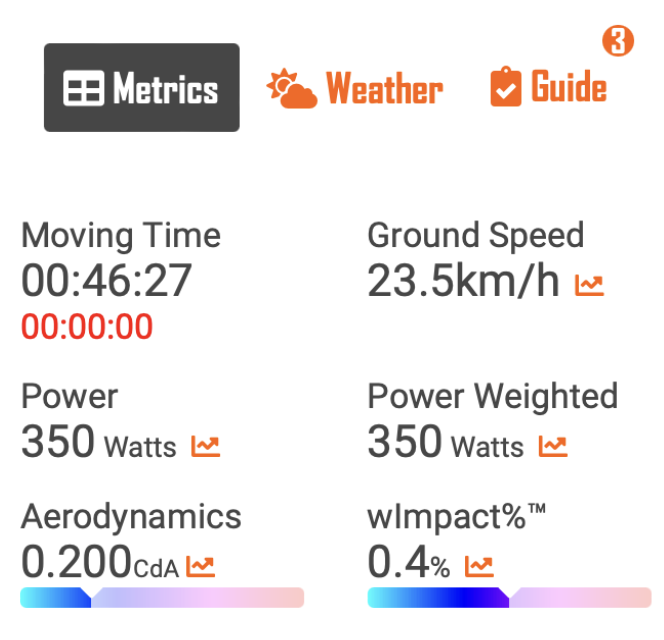
Evenly paced ride:

The evenly paced ride shows an average speed of 23.5kph with a perfectly smooth 350W (cda = 0.2 and system weight = 75kg, realistic values for a grand tour rider).

Now we shall see what time savings can be achieved with riding the flat section a touch easier and the climb a touch harder with all the same parameters…

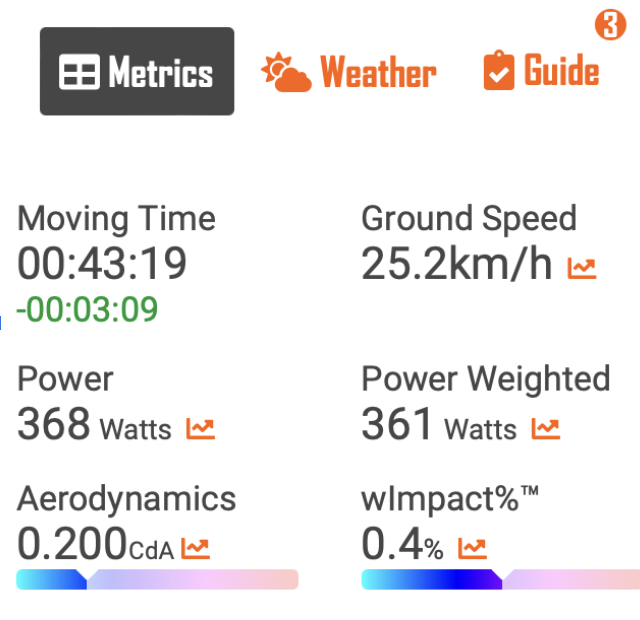
A better paced effort

Over 3 minutes saved with 18W extra and a change in pacing. On a flat course, 18W would save you roughly one third the amount of time it saves in this instance. This shows us the importance of a pacing plan and the consequences of blowing up on the last climb of a TT.

Using myWindsock to pace an effort

  1. Access myWindsock: Visit the myWindsock website or download the myWindsock app on your device. Create an account if needed.
  2. Input your time trial course: Enter the details of your time trial course into myWindsock from our library of CTT courses.
  3. Set your target time: Specify the time you want to achieve for your time trial and myWindsock will do the rest.

Welcome to myWindsock – Sign up here!

How aero can you go?

The UCI rules dictate a number of measurements cyclists must follow when setting up their time trial bikes. The nice thing about the UK is that we are not beholden to these rules very often as we follow CTT or British Triathlon, depending on whether or not we are doing a triathlon or a time trial… 

What do the UCI rules say?

The UCI (Union Cycliste Internationale) is the governing body for professional cycling and sets rules and regulations for various disciplines, including time trial racing. Time trial events are individual races against the clock where cyclists strive to complete a specified distance in the shortest time possible. These races require specialised equipment, and the UCI has established rules to ensure fairness and safety.

In terms of bicycles, UCI time trial rules dictate specific guidelines. The bike’s weight must not be less than 6.8 kilograms. The frame’s design must comply with UCI regulations, including specific tube dimensions and angles. The handlebars must be at least 3 cm wide at all points and may not extend beyond the front wheel axle.

UCI rules also stipulate that the front wheel must be the same diameter as the rear wheel, generally 700c. The use of disc wheels, also known as solid or full carbon wheels, is allowed, but they must meet UCI regulations regarding depth and dimensions. Additionally, time trial bikes are typically equipped with aero bars or triathlon bars to allow riders to maintain a more aerodynamic position. The exact dimensions and measurements of this position depend on a rider’s height, but CTT and triathletes are not beholden to these measurements. 

UCI regulations also cover clothing and equipment. Riders must wear a skinsuit, which must not extend below the knee. Shoe covers, overshoes, and other accessories must comply with specific UCI guidelines to ensure fair competition. Skinsuits cannot have external air tripping technology attached, such as the Endura D2Z skinsuit which triathletes wear a version of and is commonly seen at CTT events. 

What happens outside of these regulations? Enter “villager’s”…

Outside of these regulations, you can see some pretty obscene positions and equipment – as pioneer of rule bending (and incredible athlete) Graham Obree demonstrates in the video below.

These UCI rules aren’t followed in triathlon and we see riders going faster and faster for less power as was demonstrated in the recent Challenge Championships with riders averaging upward of 45kph with close to only around 300W.

Challenge Championships Samorin is a long-distance triathlon race held annually in Šamorín, Slovakia. It is part of the Challenge Family series, which is a global triathlon series featuring a variety of events worldwide. The race takes place in the x-bionic® sphere, a large sports and leisure complex in Šamorín.

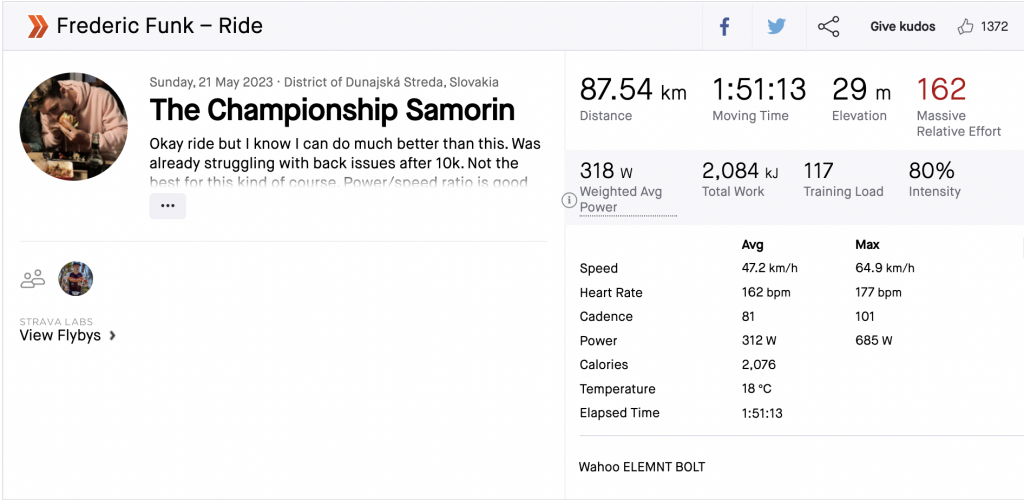
Frederic Funk’s Strava activity from Challenge Championships.

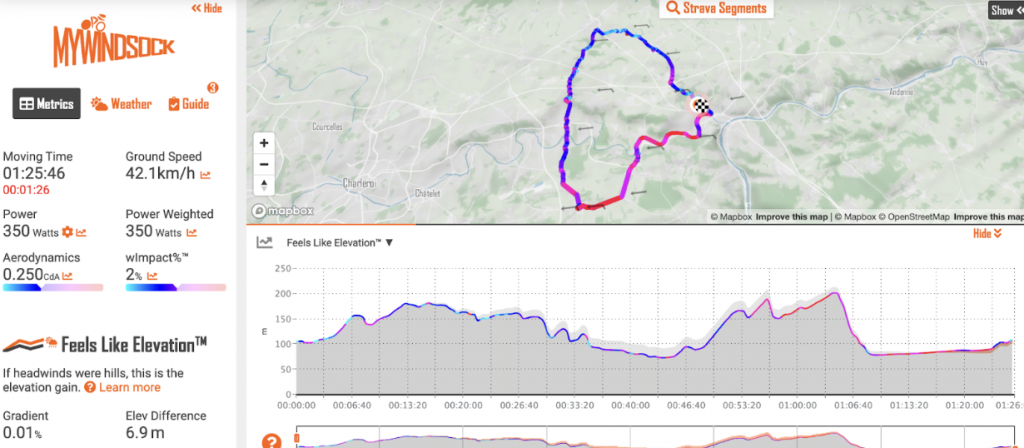
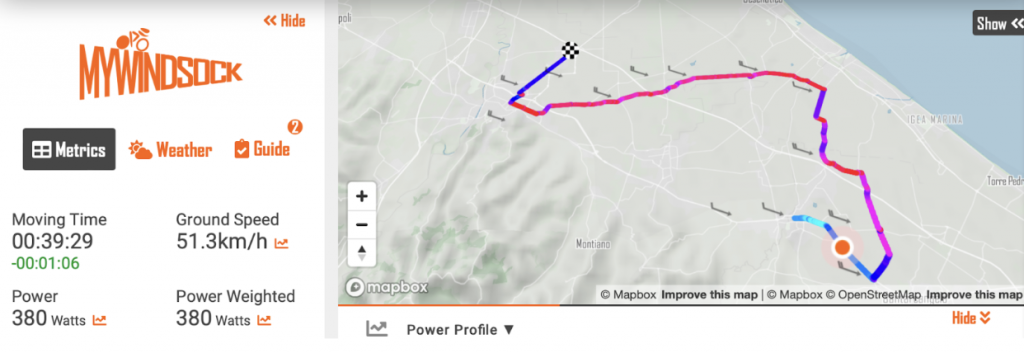
We set off to myWindsock to work out how aero triathletes actually are. Having done a little bit of estimation and some messing around with numbers on a segment called “villager’s” from the race, we came up with some aero data from the race. You can see the forecast of the segment (where Funk has the KOM) here.

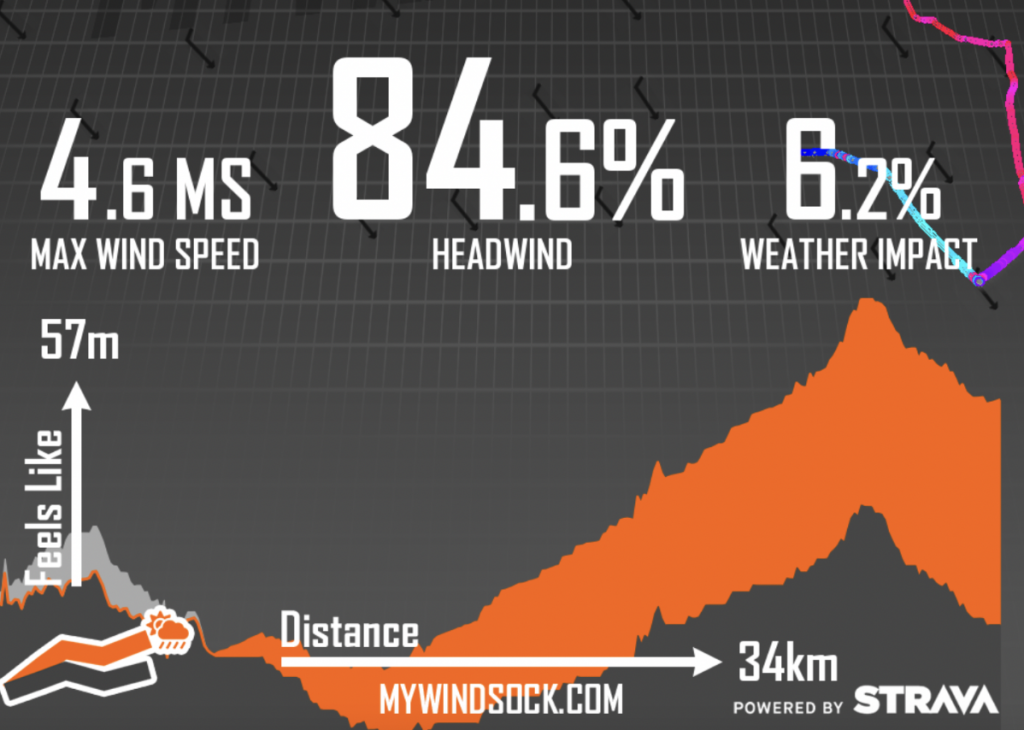
The wImpact for this segment was favourable.

Using what we could tell from Funk’s Instagram (and looking up rolling resistance data) as well as using his Strava activity for the ride we estimate his cda to be just under 0.18 – this is similar to Graham Obree’s super tuck position shown in the Youtube video embedded above! Triathletes are FAST!


If you’re not worried about UCI regulations and like going fast, all of the CTT courses are available on myWindsock and can be used in planning for your race!

The Giro – Stage 9 Analysis

The Giro d’Italia 2023 route reveal made the time trialists very happy and as a result, many have turned up. According to Pro Cycling Stats’ time trialist ranking system, 4 of the top 10 time trialists in the world have turned up including Ganna and Remco Evenepoel. Top GC time trialists like Tour de France winner Geraint Thomas and Olympic TT champ Primoz Roglic have also turned up – it’s fair to say winning a time trial at the 2023 Giro d’Italia is one of the hardest things to do in pro cycling this year. The line-up is so strong I’ve not even mentioned Kung or the fact that the current TT world champ, Tobias Foss, had to pull out as he contracted covid at the Tour de Romandie. 

The second of three time trials, and the longest of the three, takes place on Sunday the 14th of May and is the flattest of the TTs – one that was made for heavier riders like Kung and Ganna.

The stage 9 route, a twisty, flat, point to point time trial made for the bigger riders.

The course includes a number of twists and turns and will likely favour riders who are able to take these corners in their aero bars.


The forecast

No preview would be complete without a myWindsock forecast. Our previous analysis went up on Instagram and was even mentioned by Rob Hatch on Eurosport. 

The forecast at the time of writing predicts strong headwinds at the start of the day. Obviously, this is subject to change – if you’re wanting an up to date prediction of the conditions click here.

How fast will the contenders go?

Remco Evenepoel put in a thermonuclear time trial on stage one to win, full results can be seen here and we can use this, along with data released by Velon to work out how aero he was and how fast he might go for the TT on Sunday. The time to beat for GC contenders will be around the 40 minute mark.

The myWindsock (plus a bit of guessing from Tom) estimate for Remco’s time…

Our guess for what Remco might do today, anything under 40 minutes will be competitive on the stage today.

Due to the length and how flat the TT is, along with the fact that Remco didn’t look himself yesterday, on paper Kung should be favourite. Using numbers that we’ve seen in the past from him we can predict the following from FDJ rider… 

As with anything though, there are a number of factors at play including how well riders have carried form from one day to the next. One thing that could also dictate the results is how conditions are changing throughout the day. Keep up to date on our Instagram for ongoing analysis.

Being a weight weenie, is it worth it?

The question of whether or not weight matters on a bicycle is always a hotly debated topic. Usually, it’s the case that the penalties of weight loss are not worth the effort but losing weight can make a difference on hilly courses. A while ago, Ben (the founder of myWindsock) wrote a very popular blog post on how much difference 5kg can make on a course which you can read here

During hill climbs, weight really does matter – but what about other disciplines?

Why does weight matter?

Weight matters in cycling because the less weight a cyclist is carrying, the less energy they have to expend to maintain a given speed or climb a hill. This is because of the physics of cycling – as a cyclist pedals, they have to overcome two main forces: air resistance and the force of gravity.

Air resistance is determined by a combination of the cyclist’s speed and their frontal area (which is affected by body position and equipment). The faster a cyclist goes or the more upright they sit, the more air resistance they encounter. However, the effect of air resistance is relatively small compared to the force of gravity when cycling on a slope.

The force of gravity is determined by the cyclist’s weight, the slope of the road, and the acceleration due to gravity. When cycling uphill, the force required to overcome gravity increases with the slope of the road and the weight of the cyclist and their bike. The steeper the hill, the more important weight becomes.

What kind of course should I be more worried about weight than aero?

Since Ben wrote his blog, I’ve considered this question further as I have entered an off-road triathlon with a 30km bike course with 1000m of climbing total in the two laps. A scenario where weight will play a bigger role than aerodynamics on large parts of the course. Let’s see what myWindsock has to say about the course… 

The race details…

The race that I’ve entered is an Xterra branded triathlon. For those of you that don’t know, Xterra is an off-road triathlon that typically includes a mountain bike leg. The bike courses for Xterra races are usually off-road and can include singletrack, fire roads, and technical terrain. The courses are designed to be challenging and often include steep climbs, rocky descents, and other obstacles. The one I’m racing is Lake Garda, in Italy – which is extremely hilly. 

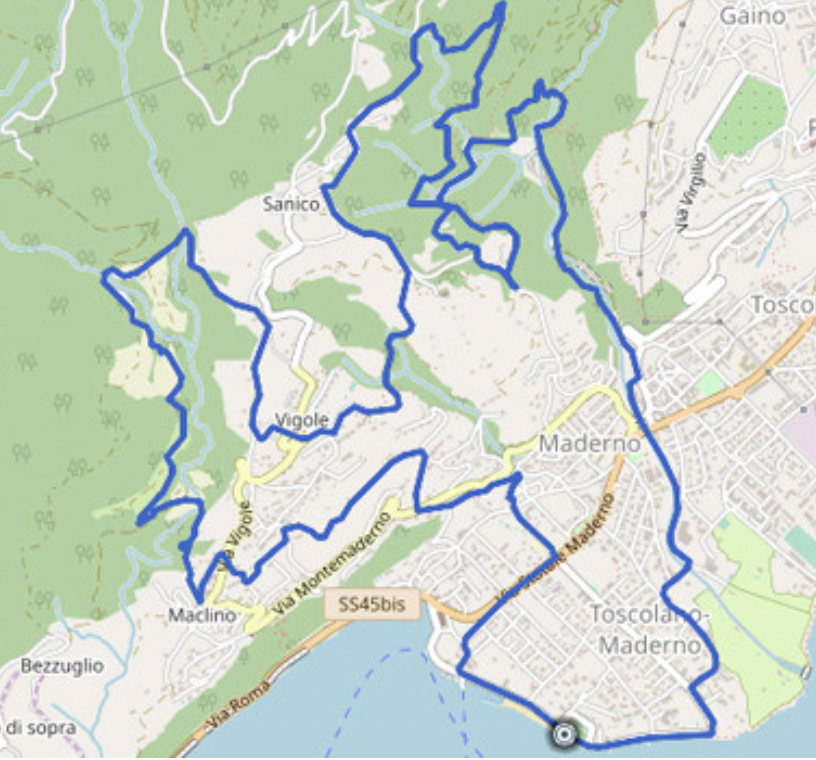
A screenshot of the course from the race website, the city loop near the shores of Lake Garda will be flat and fast but the twisty section in the forest has 1000m of climbing within the two laps.


A quick interlude on rolling resistance

One of the challenges around predicting an off road course can be rolling resistance, obviously it will vary as the surface is not the same throughout. The rolling resistance of mountain bike tires can vary depending on several factors, including the tire size, tread pattern, rubber compound, and inflation pressure.

Typically, the rolling resistance of mountain bike tires can range from around 10 to 40 watts per tire at a speed of 20 km/h on a smooth surface. However, when riding on rough terrain, the rolling resistance can be significantly higher due to the increased friction between the tire and the ground.

It’s worth noting that a lower rolling resistance typically translates to faster speeds and better efficiency, but it can come at the cost of reduced traction and durability. On the other hand, tires with higher rolling resistance may provide better traction and durability, but may be slower and less efficient. Therefore, the choice of tire depends on the rider’s priorities and the type of terrain they plan to ride on.

The coefficient of rolling resistance (Crr) is a measure of the frictional resistance between the tire and the ground, and it is typically expressed as a decimal or percentage of the tire’s weight. For mountain bike tires, the Crr can vary depending on the factors mentioned earlier, but typically ranges from around 0.004 to 0.02.

This means that for every kilogram of weight on the tire, there is a force of around 4 to 20 Newtons opposing the motion of the tire. Again, the actual Crr for a given tire can vary depending on factors such as the tire size, tread pattern, rubber compound, and inflation pressure.

You can change rolling resistance in myWindsock’s advanced options.

How much difference does a kilogram make?

Putting in our advanced settings we can have a look into how long the course might change based on weight savings. Using our initialised settings we can see the following…

The course is slow, around 19kph.

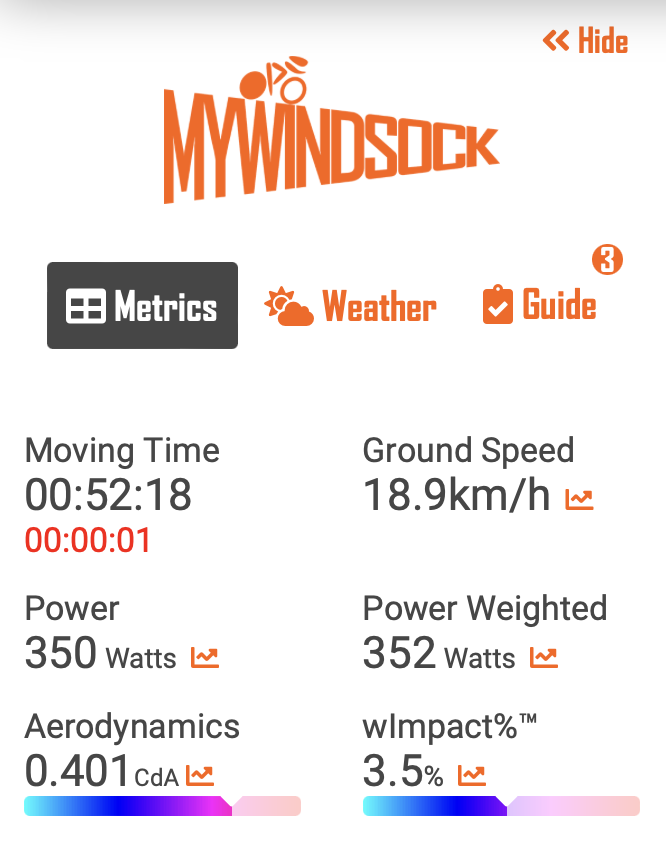
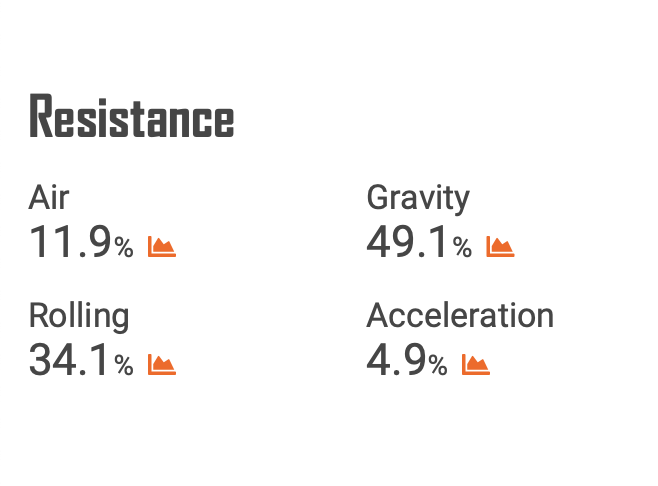
One thing that’s interesting to note is the distribution of forces, despite cda being estimated very high at around 0.4 we notice, using the force distribution graphic, that most of our resistance comes from gravity.

Gravity makes up 50% of our resistance on this course due to the lower speeds of mountain biking. That said, aerodynamics play a big role.

What happens if we lose a kg or two?

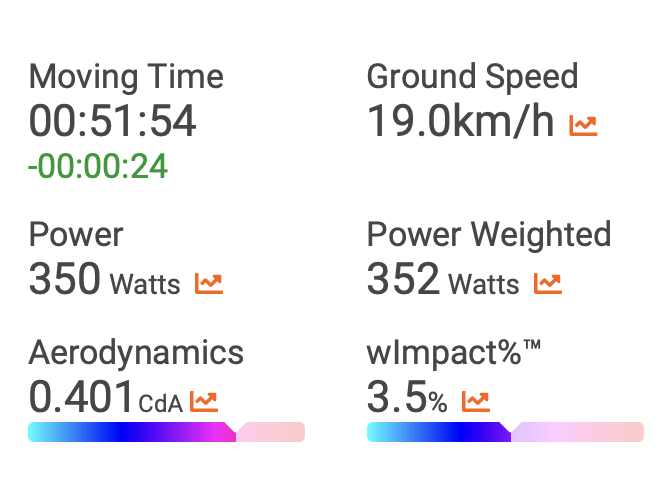
1kg gives us a significant loss of 24s over a lap, the race is two laps so in this instance a kilogram is worth almost a minute!
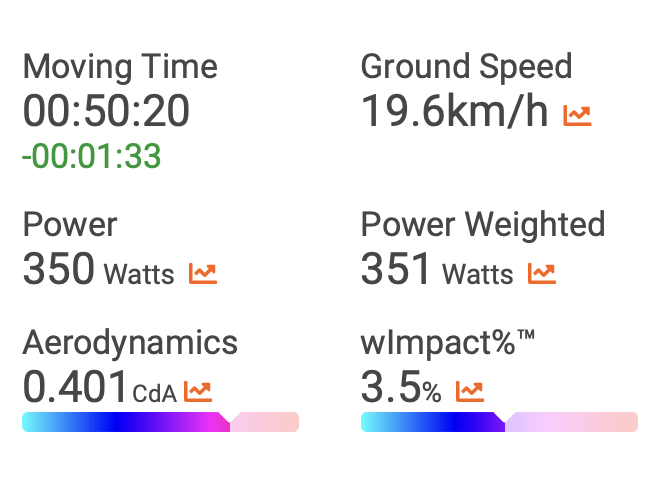
A significant 5kg loss is worth even more time. Obviously, the ability to lose 5kg depends a lot on your equipment, budget and starting bodyweight but on a hilly course with a slow rolling surface, weight will be vital.

If you want to plan your next race to the last detail, check out myWindsock and sign up today!