
 UK Time Trial Events





With the RTTC National Hill Climb championships finishing the season and cyclocross getting underway in earnest, it’s that time of year when we start seeing cyclists go out for a run. For the past decade, myWindsock has been quantifying the headwind excuse for cyclists – but how much does difference does the wind make when we run? Running is a little bit like cycling up hill in that the speeds are relatively low (the men’s 5k world record pace, for example, is only around 24kph) and you’re pushing against both wind and gravity.
A little bit of physics
Let’s first assume that we have a rider going at a constant speed along this flat course. We can write the forces here like this, where F_drive represents the force at the pedals.

As well as gravity being zero, we can replace F_aero and F_roll with their actual expressions – seeing as we know the aerodynamic equation and rolling resistance equations and replace forces with power (by doing the relevant algebra) to find the power needed to ride on a flat road.
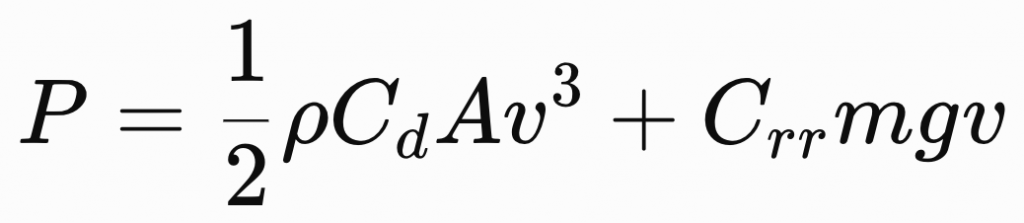
The first obvious thing to mention is that a runner doesn’t have rolling resistance, seeing as they step, not roll so we will need to replace the resistive force they get from each step with something else. The aerodynamic part equation is still relevant as they still have to push wind out of the way. An upright human has a cda of around 0.6 (according to a quick search). Assuming a runner is running half the speed of a cyclist but is half as aerodynamic, they’ll face around 1/4 of the air resistance a cyclist would – still quite a bit. Obviously running is slower than cycling, so the other resistive forces from not having wheels must add up to quite a lot…
The problem with running is you’re never travelling along at a constant speed. A runner is like a stone skipping across a lake, bouncing along and at each point of contact with the floor there’s a series of competing forces that are slowing you down or speeding you up. In between steps, runners fly gracefully (or otherwise) through the air in an arc with only air resistance and gravity acting on them.
Rather than go through a complicated derivation with lots of algebra to show off how clever we all are, let’s just skip to looking up measurements.
Cavagna, Thys and Zamboni’s 1976 paper, “The Sources of External Work in Level Walking and Running”, is particularly relevant here and also, oddly, explains why “super shoes” were a good idea a long time before they were created.
In order to understand what they found it helps to imagine how a runner moves. During running, the body’s centre of mass undergoes continuous acceleration and deceleration, both up and down and forwards. During propulsion, the body accelerates vertically and horizontally, while gravity subsequently decelerates its vertical movement (so you don’t just fly off the earth when you jump) and braking forces reduce its horizontal velocity during ground contact.
During the flight phase, the body continues moving horizontally, with its vertical trajectory governed by gravity and being slowed down by air resistance. The muscles must continually replenish the mechanical energy lost throughout these processes. A key finding from Cavagna’s research is that the body recovers very little mechanical energy between vertical and forward movement, meaning that much of the mechanical work performed during each stride must be actively regenerated by the muscles. Essentially, this paper found that humans are pretty inefficient when running – unlike bikes, which are extremely mechanically efficient.
The problem for us is to disentangle energy loss due to all of the factors that Cavagna researched from energy lost due to air resistance. This is a uniquely difficult problem as it will change based on the runner, their weight, their speed, their tendon stiffness, their shoes and much more. Imagine a runner with very floppy tendons but an extremely aerodynamic upper body – they might run the same speed as someone with a Spongebob Squarepants shaped torso but extremely springy achilles tendons, once of these runners will be significantly more impacted by the wind than the other.
If it’s hard to work out, is it easier to measure?
Luckily for us, it is. Many measurements were taken in the run up to the sub 2 hour marathon attempts that Eliud Kipchoge made which kicked off a branch of science focussed on running aerodynamics. A number of great papers have come out in recent years.
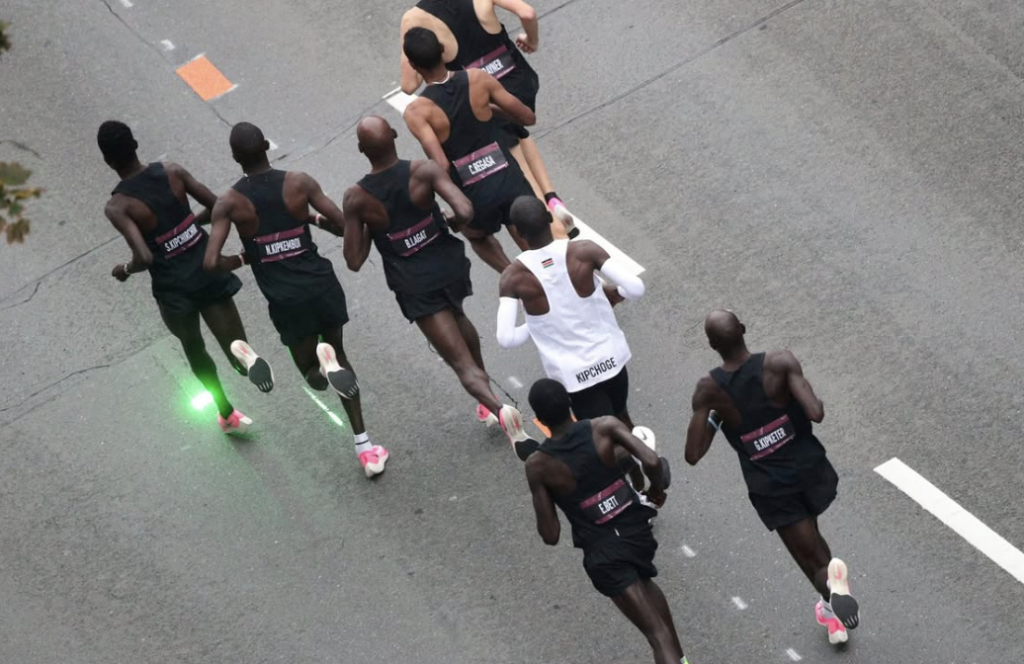
We know from experimental measurements made as long ago as the 70s that oxygen consumption with running increases with the cube of a runners’ air speed (the same as cycling). On a windless day during a 5k, wind resistance contributes approximately 8% of the oxygen cost at a given speed (a much lower proportion than cycling). Studies have also shown that this contribution practically goes to 0 with drafting (unlike cycling – where it is reduced but not such a great extent).
The study Biomechanics of Human Locomotion in the Wind looked into how aerodynamic forces influence human walking and running. This study was done in 2024 so its findings are pretty modern. Researchers had eight male participants and used an instrumented treadmill inside a wind tunnel to measure ground reaction forces, running biomechanics and aerodynamic loading.
Participants walked at 1.5 m/s and ran at 4 m/s (roughly 21 minute 5k pace) under different headwind and tailwind conditions, with wind speeds reaching 15 m/s. At the highest wind speed, running generated approximately 50 N of resistive force in a headwind and 55 N of forward aerodynamic assistance in a tailwind. The researchers also observed that participants adapted their posture in response to the wind, changing their cda.
Practically, how much difference does this make at Parkrun?
If you imagine a Parkrun course that’s an out and back like this one, where you spend 2.5km with a headwind and 2.5km with a tailwind.
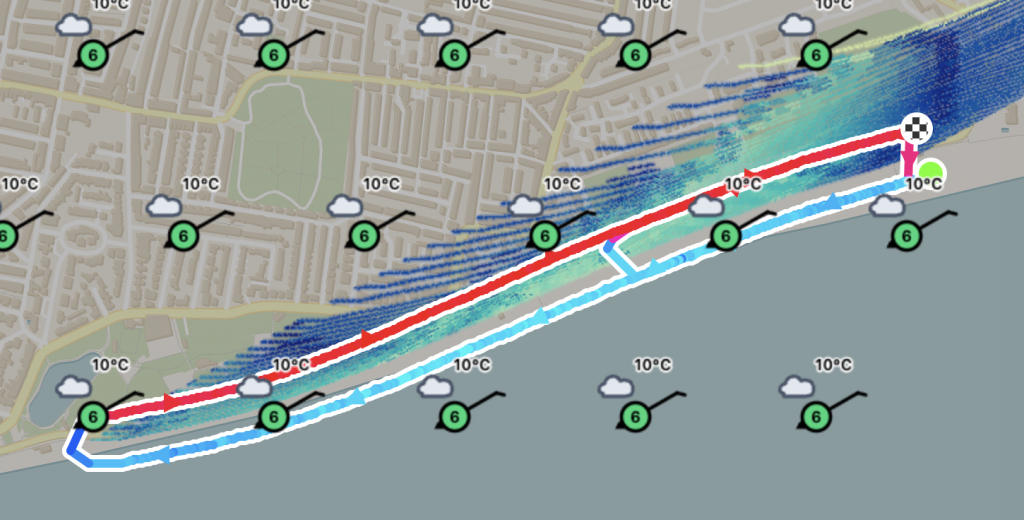
We’ve made a few calculations, and this is the rough distance the wind makes due to the headwind and tailwind effects over a 5k at various speeds:
| 5k Time | Number of seconds slower over 5k relative to a day with no wind |
| 25:00 | 55 |
| 22:30 | 45 |
| 20:00 | 43 |
| 17:30 | 35 |
| 15:00 | 30 |
