
 UK Time Trial Events




Two minutes doesn’t sound like much—until you’re halfway up the climb at National Champs and every pedal stroke fills your legs with that burning feeling. Mastering your pacing for a two-minute effort can be the difference between flying over the top or blowing up halfway.
Recent research on 800-metre runners, the ultimate two-minute specialists (ish), offers surprisingly direct lessons for hill climbers. Studies reveal exactly how elite athletes distribute effort, manage energy, and stay fast when the body is screaming to slow down.
This weekend, riders head to the National Hill Climb Championships, where the race will be won in approximately (just over) 2 minutes. Here’s how you train for and pace it…
Build a Bigger Engine (VO₂ Peak Still Rules)
Watanabe’s team found that even in a race lasting only around two minutes, athletes with higher VO₂ peak ran faster. In other words, you can’t fake endurance, even in short, explosive events. The aerobic system kicks in within seconds, not minutes, and it supports sustained output once the initial surge fades. It’s not really a revelation that having a higher VO2 max helps during a short endurance event – but the extent to which it matters does surprise a lot of people. It’s NOT a sprinter’s race!
Hill-climb takeaway:
To prepare, include workouts that stress your aerobic ceiling:
- 3–5 × 2 min uphill at 90–95% max heart rate, with full recoveries.
- Longer tempo climbs (4–6 min) at controlled effort to raise aerobic power.
A strong VO₂ peak means you’ll hit the climb harder and last longer before the legs “flood with” lactate.
Train to “clear lactate”
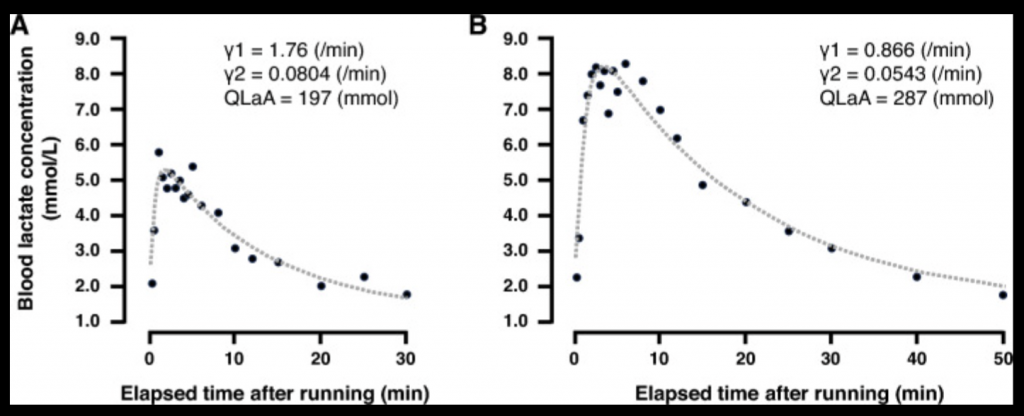
The same study identified lactate removal ability (γ₂) as a crucial determinant of performance. Those who could clear or reuse lactate faster maintained speed better through the second half of the effort. On a climb, that’s the rider or runner who keeps pushing while everyone else fades.
Hill-climb takeaway:
Train your body to tolerate and clear lactate:
- Do repeated short hill sprints (30–45 s) with 30–60 s easy recoveries.
- Add “float” intervals—alternate hard 45 s pushes and moderate 45 s efforts without full rest.
These sessions teach your muscles to recycle lactate as fuel instead of letting it shut you down.
Fast Start, Smooth Fade
Hanley’s analysis of world-class 800 m races shows that almost every top performance follows a fast-start, controlled-fade pattern: an aggressive opening to hit top power early, followed by a gradual deceleration. The secret isn’t a final sprint—it’s slowing down less than everyone else.
Hill-climb takeaway:
- Launch confidently to get up to race power quickly.
- Settle into a sustainable rhythm within 20–30 s.
- Focus on holding form as fatigue builds—shoulders relaxed, breathing deep, cadence steady.
A small fade is inevitable; the goal is to make it gradual, not catastrophic.
The Art of the Final 30 Seconds
In the last stretch, you’re no longer chasing speed—you’re fighting to keep it. This is where aerobic strength and lactate clearance combine with mental control. Keep your upper body calm, eyes fixed just ahead, and drive through the burn.
Remember: perfect pacing isn’t even pacing. It’s knowing exactly how much burn you can handle and stretching that line to the summit.
Take a look at the course here and sign up to myWindsock today!
